
Drawing on cutting-edge neuroscience, behavioral economic, and social psychology research, acclaimed author, former Harvard professor, and think tank founder Todd Rose reveals how so much of our thinking about each other is informed by false assumptions that drive bad decisions that make us dangerously mistrustful as a society and hopelessly unhappy as individuals.
COLLECTIVE ILLUSIONS:
Conformity, Complicity, and the Science of Why We Make Bad Decisions
by Todd Rose
Hachette Go, February 2022
(via Javelin)
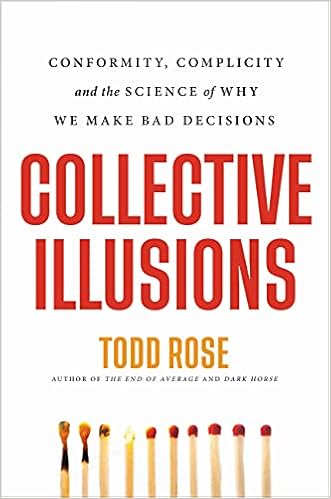 The desire to fit in is one of the most powerful, least understood forces in a society. Todd Rose believes that as human beings we continually act against our own best interests out of our brains’ misunderstanding of what we think others believe. A complicated set of illusions driven by conformity bias distorts how we see the world around us. From toilet paper shortages to kidneys that get thrown away rather than used for desperately needed organ transplants, from racial segregation to the perceived “electability” of women for political office, from bottled water to “cancel culture,” we routinely copy others, lie about what we believe, cling to tribes, and silence others. We are so profoundly social that when we are incongruent with the group that we do lasting damage to our self-worth, diminish our well-being and never realize our full potential. It’s why we all too often chase the familiar trappings of money, fame, and success that leave us feeling empty even when we do achieve them. It’s why we’ll blindly espouse a viewpoint we don’t necessarily believe in so that we blend in with the group. We trap ourselves in prisons of our own making that prevent us from living the happy, fulfilled lives we envision. The question is, Why do we keep believing the lies and hurting ourselves? Todd Rose reveals the answer is deeply hard-wired in our DNA, with brains that are more socially dependent than we realize or dare to accept. Most of us would rather be fully in sync with the social norms of our respective groups than true to who we are.
Using originally researched data, COLLECTIVE ILLUSIONS shows us where we get things wrong and just as important, how we can be authentic in forming our opinions while valuing truth. Rose offers a counterintuitive, empowering, and hopeful explanation for how we can bridge the inference gap, make decisions with a newfound clarity, and achieve fulfillment. Only then can we transform ourselves, and ultimately, society.
Social scientist Dr. Todd Rose is the co-founder of Populace, a think tank dedicated to building a world where all people have the chance to live fulfilling lives in a thriving society. He is also a faculty member at the Harvard Graduate School of Education, where he founded the Laboratory for the Science of Individuality and previously directed the Mind, Brain, and Education program. He is the author of Dark Horse: Achieving Success Through the Pursuit of Fulfillment and The End of Average: Unlocking Our Potential by Embracing What Makes Us Different.

 Human rights organisations and governments speak of a crime against humanity, a « cultural genocide ». Mihrigul Tursun has repeatedly been a victim of Chinese efforts to totally assimilate the Uyghur minority. She experienced the so-called « re-education camps » in their indescribable cruelty, the physical and psychological violence, first hand. In a way that remains unexplained to this day, her young son died while she was imprisoned. Today, despite the threat that has not disappeared even in exile, she has the courage to speak openly about what she experienced and to describe from her own experience what the Uyghur minority in China has to endure. A significant eyewitness account that brings the reader closer to the people behind the news from China.
 No one is as at home among wild woodland animals as Wolfgang Schreil: he gets up close and personal with red deer and lynxes, photographs a hunting stoat at ten paces, gets within touching distance of poisonous snakes, and stands among roe deer grazing peacefully by his side. How does he manage to get so unbelievably close to them, to share moments of connectedness that count among the happiest times of his life? For Wolfgang ‘Woid Woife’ Schreil, the woods represent a safe haven and place where we can be truly free. His gripping stories, his priceless knowledge of the animal world and his close-up animal photographs have made him a very special woodland ambassador. His immense passion for life and animals, his faith in the power of love, and his belief that nature’s greatest gifts are revealed to us if we are only patient, are an inspiration for each and every one of us who yearn to be mindful of what really matters.
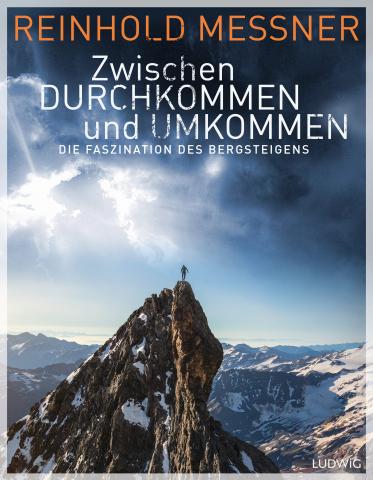 Old-school mountaineers confront the unknown with courage and self-sufficiency. They go where no one else dares to go, and take unbelievable risks. Ever since man first stood on top of Mont Blanc in 1786, they have continuously pushed the boundaries of the supposedly impossible. Reinhold Messner’s new book is a memorial to those pioneers, a history of traditional mountaineering told through the stories of its most celebrated heroes, often in their own words. Messner’s incisive essays reveal the mental and physical qualities needed to achieve what they did: qualities such as courage and passion, self-reliance in the face of danger, and the ability to focus on important things – and the refusal to use technically sophisticated gear.