
An examination of the profound impact that the War on Terror had in pushing American politics and society in an authoritarian direction.
REIGN OF TERROR:
How the 9/11 Era Destabilized America and Produced Trump
by Spencer Ackerman
Viking, August 2021
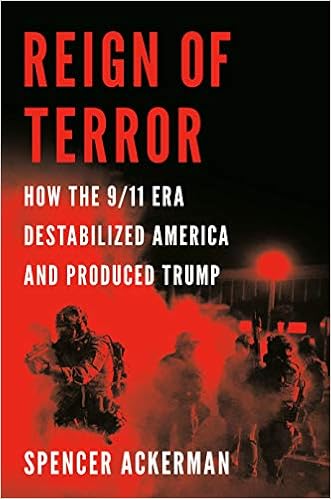 For an entire generation, at home and abroad, the United States has waged an endless conflict known as the War on Terror. In addition to multiple ground wars, it has pioneered drone strikes and industrial-scale digital surveillance, as well as detaining people indefinitely and torturing them. These conflicts have yielded neither peace nor victory, but they have transformed America. What began as the persecution of Muslims and immigrants has become a normalized, paranoid feature of American politics and security, expanding the possibilities for applying similar or worse measures against other targets at home. A politically divided country turned the War on Terror into a cultural and then tribal struggle, first on the ideological fringes and ultimately expanding to conquer the Republican Party, often with the timid acquiescence of the Democratic Party. Today’s nativist resurgence walked through a door opened by the 9/11 era.
REIGN OF TERROR will show how these policies created a foundation for American authoritarianism and, though it is not a book about Donald Trump, it will provide a critical explanation of his rise to power and the sources of his political strength. It will show that Barack Obama squandered an opportunity to dismantle the War on Terror after killing Osama bin Laden. That mistake turns out to have been portentous. By the end of his tenure, the war metastasized into a broader and bitter culture struggle in search of a demagogue like Trump to lead it. A union of journalism and intellectual history, REIGN OF TERROR will be a pathbreaking and definitive book with the power to transform how America understands its national security policies and their catastrophic impact on its civic life.
As a journalist, Spencer Ackerman has spent his entire career on subjects we would like to turn our heads away from. He broke the story of Homan Square in Chicago, and Dan Jones’ report on torture. Over the past 17 years, he covered national security and the war on terrorism as a staff reporter for The New Republic, Wired and The Guardian, as well as other publications, where he reported from Iraq, Afghanistan, Guantanamo Bay and a number of military bases, naval ships and submarines. While at the Guardian, he was part of the team reporting on Edward Snowden’s NSA leaks, which won the 2014 Pulitzer Prize for Public Service Journalism, the Scripps Howard Foundation’s 2014 Roy W. Howard Award for Public Service Reporting, and the 2013 IRE medal for investigative reporting. Ackerman’s Wired series on Islamophobic counterterrorism training at the FBI won the 2012 online National Magazine Award for reporting. He frequently appears on MSNBC, CNN and other news networks. He has over 147,000 Twitter followers.
 These new and collected essays from the acclaimed naturalist Barry Lopez—his final undertaking—represent the culmination of a lifetime’s thought in service of our relationship with wilderness, and with each other. Here, his collected essays offer a unifying vision; his drive to reconnect the cultural and the natural is unflinching, and major, never-published pieces offer profound commentary on topics that veer from the autobiographical—his abuse as a child—to the evolution of his views on the untamed. His classic prose, like the arctic landscape he elegized, remains as ever: “spare, balanced, extended…” It has been said that Barry Lopez understood what we gain when we accept the enormity of what we don’t know; these essays hinge on that tantalizing concept.
 Raquel Willis is a powerful woman. But growing up as a young boy in the South made being herself almost impossible. In this moving and provocative memoir, Raquel relives the many risks she faced in her struggle to become a fierce advocate for her community—and the powerful woman—that she is today. Today, she is known as a transgender trailblazer, both for work with the Transgender Law Center and speaker at the National Women’s March. She offers intimate reflections on masculinity and blackness, informed by a tumultuous relationship with her father. From a childhood built in opposition to expectations, all the way through her transition at a flagship Southern university, Raquel demonstrates that her story is but one thread in the larger tapestry of Black trans American life; a tapestry that has never truly been chronicled from this millennial, Southern perspective.
 There are three important laws in Ezomo’s village: Don’t go to The Valley, don’t go out at night, and never, ever, ever open the door that protects them all. But when Ezomo encounters the leopard believed to have killed his father, he and his two friends embark on a journey that leads them past the boundaries set by their elders. Ezomo’s mother immediately falls deathly ill, and Ezomo doesn’t believe that it’s a coincidence. Eventhough he wasn’t able to save his father, Ezomo hopes he can save her. He receives a hint that the cure can be found behind the village door, in the Valley. With his friends by his side, Ezomo discovers the true history of his village, and that cautionary tales exist for a reason.
 Adelle and Connie have been best friends for years, united by their love of a little known novel called