A historic presidential campaign changes the trajectory of a young Black man’s life in the highly anticipated debut novel from one of The New Yorker’s rising stars.
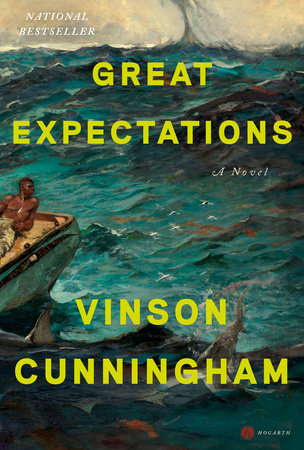
GREAT EXPECTATIONS
by Vinson Cunningham
Hogarth, March 2024
(via Sterling Lord Lieristic)
 “I’d seen the Senator speak a few times before my life got caught up, however distantly, with his, but the first time I can remember paying real attention was when he delivered the speech announcing his run for the Presidency.”
When David first hears the Senator from Illinois speak, he feels deep ambivalence. Intrigued by the Senator’s idealistic rhetoric, David also wonders how he’ll balance the fervent belief and inevitable compromises it will take to become the United States’s first Black president.
GREAT EXPECTATIONS is about David’s eighteen months working for the Senator’s presidential campaign. Along the way David meets a myriad of people who raise a set of questions—questions of history, art, race, religion, and fatherhood, all of which force David to look at his own life anew and come to terms with his identity as a young Black man and father in America.
Meditating on politics and politicians, religion and preachers, fathers and family, GREAT EXPECTATIONS is both an emotionally resonant coming-of-age story and a rich novel of ideas, and marks the arrival of a major new writer.
“The aptly-titled GREAT EXPECTATIONS announces Vinson Cunningham as a novelist of singular style, wit and ambition. Focused on one young man’s experience working on a historic presidential campaign, the novel is both a coming-of-age story for its narrator and—just as powerfully—a coming-of-age tale for the nation writ large. Cunningham has an uncanny ability to access the thoughts undergirding our thoughts, and his narrator is one that readers will wish they could keep by their sides to make sense of the world after the book’s final pages. Read GREAT EXPECTATIONS and see our recent past, our present, and even our future anew.” —Angela Flournoy, author of The Turner House, finalist for the National Book Award
Vinson Cunningham is a staff writer and a theatre critic at The New Yorker. His essays, reviews, and profiles have appeared in The New York Times Magazine, The New York Times Book Review, FADER, Vulture, The Awl, and McSweeney’s Internet Tendency. A former staffer on Barack Obama’s first presidential campaign and in his White House, Cunningham has taught at Sarah Lawrence College, the Yale School of Art, and Columbia University’s School of the Arts. He lives in New York City. GREAT EXPECTATIONS is his first novel.

 BEARTOOTH is the story of Thad and Hazen, two brothers from Yellowstone country. Fatherless, abandoned by their mother, and tired of eking out a livelihood poaching bears and chopping firewood, they reluctantly agree to help a mysterious, kilt-wearing Scotsman smuggle elk antlers out of the national park; it turns out rich folks building ski houses want them for chandeliers.
 In the English countryside—decimated by heat and drought—Penelope archives what remains of an estate’s once notable art collection. The crumbling country house has been her home for two decades and a refuge for those who have been displaced by disasters, but it is scheduled for demolition in a few months’ time. With this pressing deadline comes the impending return of Aidan’s brother, Julian, at whose hands Penelope suffered during a brief but violent relationship twenty-two years before. As Julian’s visit looms, Penelope finds herself unable to suppress the past, and she clings to art as a means of understanding, of survival, and of reckoning.
 A daughter has disappeared. She has travelled to Syria to marry a jihadist she met online. Her father Murad blames himself. If he had only told Naima more about his old homeland, which he has left behind mentally, as well as physically; if only he had paid more attention to her feelings of alienation – perhaps then she wouldn’t have gone to a strange country in the name of religion. Murad knows he must find Naima. He contacts human traffickers and travels to the Kurdish territory on the Turkish-Syrian border, where he comes face to face with his past. When the traffickers play him an audio diary recorded by a woman in Raqqa – probably Naima – Murad sets out on a perilous journey into ISIS territory…
 It is August 1943. Fourteen-year-old Massimo is an orphan fleeing south to Naples from Rome after his parents are killed in an American bombing raid. After he is attacked by thugs at the base of the Benedictine abbey of Montecasino, a man who calls himself Pietro Houdini (“Master Artist and confident of the Vatican!”) brings him inside. Unfortunately, the abbey sits on the German’s Gustav Line, and the allies are coming north. In the months to follow, Massimo, Pietro Houdini, the mysterious “black angel” named Ada, the cafe owner and murderer Bella Bocci, the wounded but chipper German soldier Harald, and the lovers Dino and Lucia (on their wounded mule named Ferrari) will lie, cheat, steal, fight, kill, and sin their way through the front line of the World War II to survive, all while smuggling three Titian Renaissance paintings they stole from the Nazis who were stealing them from the monks.