
When Cisco Collins returns to his home town thirty years after saving it from being swallowed by a hell mouth opened by an ancient pirate ghost, he realises that being a childhood hero isn’t like it was in the movies. Especially when nobody remembers the heroic bits – even the friends who once fought alongside him..
SWASHBUCKLERS
by Dan Hanks
Angry Robot, November 2021
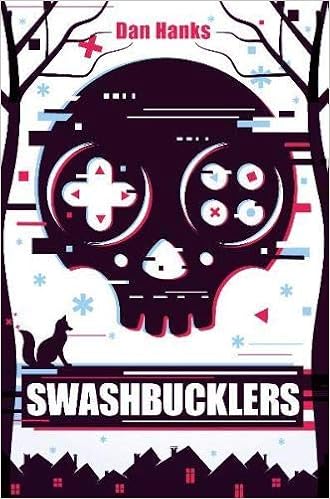 Struggling with single parenting and treated as bit of a joke, Cisco isn’t really in the Christmas spirit like everyone else. A fact that’s made worse by the tendrils of the pirate’s powers creeping back into our world and people beginning to die in bizarre ways. With the help of a talking fox, an enchanted forest, a long-lost friend haunting his dreams, and some 80s video game consoles turned into weapons, Cisco must now convince his friends to once again help him save the day. Yet they quickly discover that being a ghostbusting hero is so much easier when you don’t have schools runs, parent evenings, and nativity plays to attend. And even in the middle of a supernatural battle, you always need to bring snacks and wipes…
SWASHBUCKLERS is a middle-aged, parenting Ghostbusters at Christmas tale, which blends British folklore and a tiny bit of time travel into the mix too. It explores what happens when those childhood heroes like the Goonies grow up. Do they ever get over what happened? Do some of them hang onto those adventures too much and forget to live in the present? And what happens when they’re forced back together to save the day again?
Dan Hanks is a writer and editor based in the rolling green hills of the Peak District with his human family and fluffy sidekicks Indy and Maverick. One of the co-founders of the OcTBR Challenge and a a long-time reviewer for Fantasy Faction, he writes books, screenplays and comics when he’s not wasting time on Twitter.
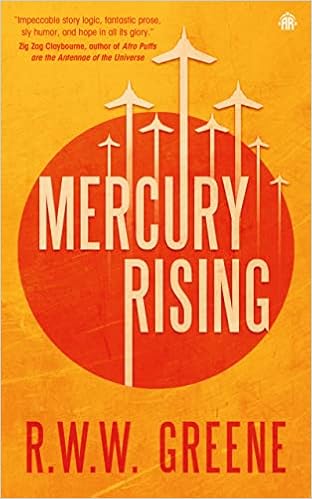 For the past 10 years, most of the folks on Earth have believed they are at war with the planet Mercury. Because of the distances involved, it’s largely been a cold war, lots of posturing with occasional blow ups and sneak attacks. In this alt-history, humans made it into space in the late ‘40s, with lots of flash and Buck-Rogers panache, thanks to the Oppenheimer Nuclear Engine. As a result, the planet was ready, in 1967 to fend off an initial invasion force. Most of the defenders were killed, but those that returned gave evidence and the world banded together for a common defense. But, war is profitable and there is more to the story about this so-called war than anyone knows.
 Rosalind Franklin knows if she just takes one more x-ray picture—one more after thousands—she can unlock the building blocks of life. Never again will she have to listen to her male colleagues complain about her, especially Maurice Wilkins who’d rather conspire about genetics with James Watson and Francis Crick than work alongside her. Then it finally happens—the double helix structure of DNA reveals itself to her with perfect clarity. Photograph 51. But Rosalind never could have predicted how far her colleagues would go to erase her names from the history books. Marie Benedict’s next powerful novel shines a light on a woman who died to discover our very DNA, a woman whose contributions to science were suppressed by the men around her but whose relentless drive advanced our understanding of humankind.
 Silas is dead. Or he’s almost dead, felled by the trees he was felling and now brought home, comatose, to die in his unfinished, off-the-grid house at the edge of the forest he loved. His wife, Elsa, doesn’t know much about living in the country, about running the generator or chopping enough wood to survive the winter. Raising their children here, in this dwelling carved into the side of a hill, had been Silas’s dream, not hers. She doesn’t know how she’ll ease his final days with no heat and no running water. But she knows that he would want to stay here, in his bed, on his land, as his breath shudders to a whisper.
 You’ve seen the smooth, uncanny artifacts: a blank, white café that looks like it could be located anywhere in the world; TikTok dance videos repeating in a dull echo; restaurant design and food plating which begs to be posted on Instagram; endlessly bingeable streaming television; influencers’ faces made up and surgically altered towards a certain photogenic ideal. While appearing in different mediums, these pieces of culture are characterized by a slick sameness. Rather than provoking us, they’re pleasing, ambient, frictionless.