
The graphic novel of the bestselling book by Germany’s most famous living philosopher, for readers of Sapiens by Yuval Noah Harari and Sophie’s World by Jostein Gaarder.
WER BIN ICH – UND WENN JA, WIE VIELE? DIE GRAPHIC NOVEL
(Who Am I – And If Yes, How Many? The Graphic Novel)
by Richard David Precht & Martin Möller
illustrated by Jörg Hartmann
Goldmann/PRH Germany, Septembre 2024
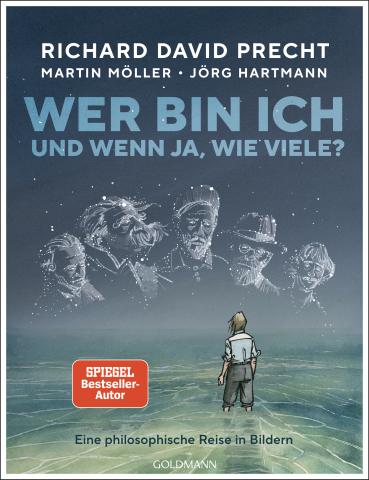 Precht’s « Who Am I – And If Yes, How Many? » introduced millions of readers to the big philosophical questions of our time, making him one of Germany’s most famous authors. A good fifteen years later, it is being published again – this time as a graphic novel. Illustrated by Jörg Hartmann, it gives us Precht’s wisdom inside a modern aesthetic. Everything we know about ourselves from neuroscience, psychology and philosophy is contained within its pages – creating a unique path through the plainly mind-boggling amount of information out there about what it means to be human.
Richard David Precht, born in 1964, is a philosopher, journalist, and author, and one of the most distinguished intellectuals in the German-speaking countries. He is an honorary professor of philosophy and aesthetics at the Hanns Eisler Academy of Music in Berlin. Ever since his sensational success with Who Am I – And If Yes, How Many?, his books about philosophy and society have been consistent bestsellers, and they have been translated into 40 languages. Since 2012 he has presented the philosophy programme Precht on the TV channel ZDF, and he discusses social, political and philosophical issues with Markus Lanz on the weekly hit podcast Lanz & Precht.
 It’s a given that, as far as work is concerned, nothing these days is a given. The Second Machine Age of self-teaching computers and robots will revolutionise not only the job market, but also redefine what ‘work’ is in the first place, and why we still do it. What happens when machines do so much of the work that economies no longer need to rely on human productivity? Without the old wage labour society of the First Machine Age, our conception of work as defined by the nineteenth century will become a mere appendix – useless and outdated. The big prize we aim for will no longer be full-time work, but self-realisation, and the raffle tickets will change accordingly: society will cease to think of employment as the be-all and end-all, and place greater value on high-quality jobs and workplace conditions.