
A groundbreaking work of investigative nonfiction on life in China’s burgeoning surveillance state.
SURVEILLANCE STATE:
Inside China’s Quest to Launch a New Era of Social Control
by Josh Chin and Liza Lin
St. Martin’s Press, September 2022
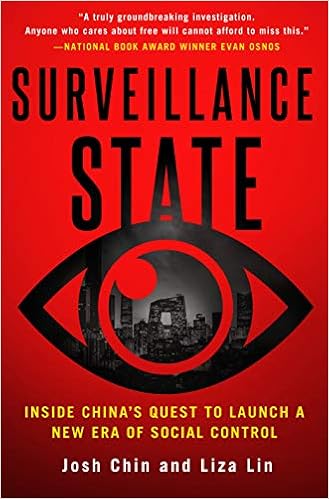 People living in democracies have for decades drawn comfort from the notion that their form of government, for all its flaws, is the best history has managed to produce. SURVEILLANCE STATE documents with startling detail how even as China’s Communist Party pays lip service to democracy as a core value of “socialism with Chinese characteristics,” it is striving for something new: a political model that shapes the will of the people not through the ballot box but through the sophisticated―and often brutal―harnessing of data.
On the country’s remote Central Asian frontier, where a separatist movement strains against Party control, China’s leaders have built a dystopian police state that keeps millions under the constant gaze of security forces armed with AI. Across the country in the city of Hangzhou, the government is weaving a digital utopia, where tech giants help optimize the friction out of daily life. Award-winning journalists Josh Chin and Liza Lin take readers on a journey through both places, and several in between, as they document the Party’s ambitious push―aided, in some cases, by American technology―to engineer a new society around the power of digital surveillance.
China is hardly alone. As faith in democratic principles wavers, advances in surveillance have upended debate about the balance between security and liberty in countries around the globe, including the US. Succeed or fail, the Chinese experiment has implications for people everywhere.
Josh Chin is Deputy Bureau Chief in China for The Wall Street Journal. He previously covered politics and tech in China for the newspaper for more than a decade. He led an investigative team that won the Gerald Loeb Award for international reporting in 2018. Born in Utah, he lives in Taiwan.
Liza Lin works as the journalist covering data use and privacy for The Wall Street Journal from Singapore. Liza was part of the Journal team that won the Loeb in 2018. Prior to the WSJ, Liza spent nine years at Bloomberg News and Bloomberg Television.
 Do you feel just a bit crap, most of the time? We’re not talking major depression here but rather that constant underlying feeling of being underwater, struggling beneath the surface of life. It’s because of your tiny t – the small, everyday traumas that you’ve endured all your life which have led you to living on autopilot, slightly numb to the world. This book will show you how to come alive once again – and flourish, rather than languish, in a life less lived.
 Anti-fatness is everywhere. In WHAT WE DON’T TALK ABOUT WHEN WE TALK ABOUT FAT, Aubrey Gordon unearths the cultural attitudes and social systems that have led to people being denied basic needs because they are fat and calls for social justice movements to be inclusive of plus-sized people’s experiences. Unlike the recent wave of memoirs and quasi self-help books that encourage readers to love and accept themselves, Gordon pushes the discussion further towards authentic fat activism, which includes ending legal weight discrimination, giving equal access to health care for large people, increased access to public spaces, and ending anti-fat violence. As she argues, “I did not come to body positivity for self-esteem. I came to it for social justice.”
 « I’ve seen the future of horror . . . and his name is Clive Barker. » In the mid-1980s, Stephen King inducted a young English novelist into the world of great genre writers, and since then, this genius creator has only continued to expand his field of activity. Created by his two most loyal collaborators, Phil and Sarah Stokes, CLIVE BARKER’S DARK WORLDS is the first book to shed light on the massive scope of Barker’s creative work. With the help of Barker himself, this book contains exclusive insight from those who have worked with him creatively and professionally, alongside analyses of his works and comments over four decades from industry contemporaries and friends such as Ramsey Campbell, Quentin Tarantino, Neil Gaiman, China Miéville, Peter Straub, Armistead Maupin, J.G. Ballard, Wes Craven, and many more.
 First breaking out into the international scene with festival-favorite