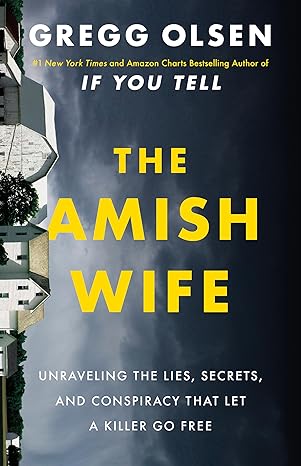
The bestselling author Gregg Olsen solves a murder among the Amish and reveals the conspiracy to keep it a secret in a heartbreaking and horrifying true-crime story, THE AMISH WIFE.
THE AMISH WIFE
Unraveling the Lies, Secrets, and Conspiracy That Let a Killer Go Free
by Gregg Olsen
Thomas & Mercer, January 2024
(via David Black Literary Agency)
 What if the first true crime story you ever wrote (Abandoned Prayers) had loose ends that haunted you for more than thirty years?
What if you had a second chance to right a wrong, solve a murder, and bring justice to a woman who had none?
Would you take a second bite of the apple?
Gregg Olsen didn’t think twice. A call from an Amish farmer brought Olsen back into a story that never left him and gave him the chance to answer the question once and for all.
Who killed Ida Stutzman?
The young, pregnant Ohio Amish woman died in a barn fire. Her death was declared by natural causes. Soon after, her husband, Eli Stutzman, sold the farm, left the faith, and set off on an odyssey of sex, drugs, and erratic behavior that would culminate in the death of his and Ida’s young son, Danny—a mysterious crime (“Little Boy Blue of Chester, Nebraska”) that gained national attention and inspired Olsen’s true crime classic, Abandoned Prayers.
Now, in THE AMISH WIFE: Unraveling the Lies, Secrets, and Conspiracy That Let a Killer Go Free, Gregg Olsen revisits the Stutzman story and the niggling questions surrounding the events that took Ida’s life 45 years ago.
Why did the coroner so quickly rule the young mother’s death heart failure? Why didn’t the county sheriff investigate the circumstances behind her death? How come Ida’s relatives repressed their doubts about her death and never publicly expressed their concerns—even after all this time?
The answers were found between the two worlds that Eli Stutzman inhabited—the gay and Amish.
Gaining greater access than most outsiders are afforded, Olsen takes readers deep into the circumscribed world of an Amish community and beyond as he pieces together the puzzle surrounding Ida’s death. The gay men in Eli’s life Olsen met more than three decades ago, like the Amish, were freer in 2022 to speak a truth they’d kept silent out of a fear that has lessened over the years.
Just how much did a conspiracy of silence shared by inhabitants of two very different words become complicit in an Amish wife’s death and, later, her son’s?
#1 New York Times bestselling author Gregg Olsen has written more than thirty books, including If You Tell, Lying Next to Me, The Last Thing She Ever Did, and two novels in the Nicole Foster series, The Sound of Rain and The Weight of Silence. His last true crime book, If You Tell, found a home on Amazon Charts for more than 180 weeks and was the bestselling Kindle eBook of 2020 (and the second bestselling of 2021). He has appeared on Good Morning America, Dateline, Entertainment Tonight, CNN, and MSNBC and been featured in Redbook, People, Salon, the Seattle Times, Los Angeles Times, and New York Post. His fiction and nonfiction works have appeared on the USA Today and Wall Street Journal and New York Times bestseller lists. A Seattle native, he lives with his wife in rural Washington State.

 To be common is to be an everyday person. It’s to do the things that you are expected to do, whether that’s what your parents want for you, or your employer, or your spouse, et cetera. But if you want to be more than you are, more than you think you can be, then you need to recognize and learn from your mistakes to lead a life of excellence.
 Women are often socialized to prioritize the needs of others, leaving little time for themselves. In this book, women are equipped with 101 practical and encouraging self-care activities—organized around the five pillars of self-care—to help them care for, replenish, and reconnect with themselves and live a more joyful life.
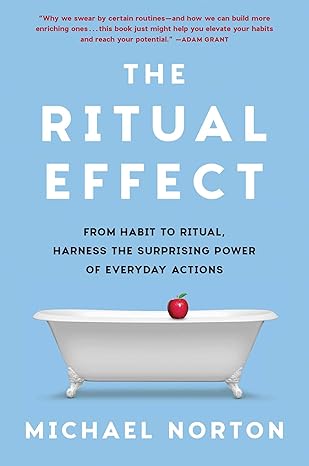 Our lives are filled with repetitive tasks meant to boost productivity—what we know as habits. Over time, we do these activities automatically. But when we perform these habits mindfully—when we focus on the precise way an act is performed—we create a ritual. Now, an everyday act goes from black-and-white to technicolor. And as author and Harvard professor Michael Norton explains here, it’s these rituals that make life worth living.
 Henry Winkler, launched into prominence as “The Fonz” in the beloved Happy Days, has transcended the role that made him who he is. Brilliant, funny, and widely-regarded as the nicest man in Hollywood (though he would be the first to tell you that it’s simply not the case, he’s really just grateful to be here), Henry shares in this achingly vulnerable memoir the disheartening truth of his childhood, the difficulties of a life with severe dyslexia, the pressures of a role that takes on a life of its own, and the path forward once your wildest dream seems behind you.