
Spectacular finds throw a new light on the history of human evolution
WIE WIR MENSCHEN WURDEN
(How We Became Human)
by Madelaine Böhme, Rüdiger Braun, & Florian Breier
Heyne/Random House Germany, November 2019
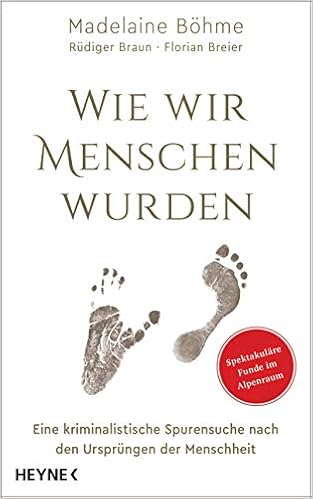 A criminalistic search for clues of the origins of humanity
The cradle of humanity is in Africa – for a long time this was the incontrovertible truth. In recent years, however, ever more bones have been found that chronologically and geographically do not fit into the picture: archaeologists have found numerous fossils in Europe of early ancestors of present-day apes from which later the human line of evolution emerged. The latest of those findings: the Danuvius guggenmosi, an ape with arms suited to hanging in trees but human-like legs.
In the renowned Nature magazine, Madelaine Böhme and her team just published their research article on this new fossil ape and how it changes the previously applied models of the evolution of bipedalism. These approximately 11.6-million-year-old fossils suggest a form of locomotion that might push back the timeline for when walking on two feet evolved and extend the theory for a common ancestor of great apes and humans. In her book, Böhme and her team describe their paradigm-changing findings and bring to life the fascinating world of our earliest ancestors. A truly absorbing scientific crime story!
Madelaine Böhme, geo-scientist and palaeontologist, is professor of terrestrial palaeoclimatology at the University of Tübingen and founding director of the Senckenberg Center for Human Evolution and Palaeoenvironment. She is one of the most esteemed palaeoclimatologists and palaeoenvironmental scientists examining human evolution with regard to changes in climate and environment.
Rüdiger Braun is a science journalist and contributes to Stern and Geo.
Florian Breier is a science journalist and works as a filmmaker and author for ZDF television, arte, SWR broadcasting and others.
 Why there is no me without you – the new major book by bestselling author Joachim Bauer.
 In THE VOYAGE OF SORCERER II, Venter and science writer David Ewing Duncan tell the remarkable story of these expeditions and of the momentous discoveries that ensued―of plant-like bacteria that get their energy from the sun, proteins that metabolize vast amounts of hydrogen, and microbes whose genes shield them from ultraviolet light. The result was a massive library of millions of unknown genes, thousands of unseen protein families, and new lineages of bacteria that revealed the unimaginable complexity of life on earth. Yet despite this exquisite diversity, Venter encountered sobering reminders of how human activity is disturbing the delicate microbial ecosystem that nurtures life on earth. In the face of unprecedented climate change, Venter and Duncan show how we can harness the microbial genome to develop alternative sources of energy, food, and medicine that might ultimately avert our destruction.
 Babies truly are miracles in learning: Sebastian Berger introduces us to the fascinating world of early infant learning, describes the development in the brain areas that enable learning, and gives insights into the respective cognitive research. He shows that babies not only learn much faster than adults, but