
A darkly funny and much gayer imagining of the classic prep school novel, IDLEWILD will appeal to readers of Curtis Sittenfeld’s Prep and Donna Tartt’s The Secret History.
IDLEWILD
by James Frankie Thomas
Overlook/Abrams, Fall 2023
(via Frances Goldin Literary)
 Idlewild is a tiny, artsy Quaker high school in lower Manhattan. Students call their teachers by their first names, there are no grades or awards, and every day begins with 20 minutes of contemplative silence. It is during one of those moments of worship that two airplanes hit the World Trade Center.
For two Idlewild outcasts, 9/11 serves as the first day of an intense, 18-month friendship. Fay is a prickly, aloof rich kid who is obsessed with gay men; Nell is a shy, sensitive scholarship student who is obsessed with Fay. The two of them bond fiercely over being the only two openly queer kids at Idlewild. But, as they rehearse for the school’s production of Othello, they notice two sexually ambiguous boys, Theo and Christopher, who are potential candidates for their exclusive Invert Society (née Gay-Straight Alliance). The pairs become mirrors of one another’s desires, anxieties, and loneliness. Their devotion to one another becomes an obsession, driving them to do things that they’ll regret for the rest of their lives.
Looking back on these events as adults, Fay and Nell, who haven’t spoken to each other in fifteen years, are haunted by shame over their Idlewild days. From alternating perspectives, they wonder if they could have done anything to save their friendship, or if it was meant to remain an artifact that couldn’t have existed outside of Idlewild’s walls.
James Frankie Thomas holds an MFA in fiction from the Iowa Writers’ Workshop. Their fiction has been published in the Paris Review online, Vol. 1 Brooklyn, and The Toast, among other publications. One of these essays is included in the anthology We Are the Baby-Sitters Club, and another was adapted into a PBS NewsHour segment.
 Two years after the death of their mother, Jada and Maddy Battle both face unplanned pregnancies. Jada, a thirty-one-year-old psychology PhD student living in Pittsburgh, quietly obtains an abortion without telling her husband, but the secret causes turmoil in her already shaky marriage. Back home in rural Pennsylvania, nineteen-year-old Maddy, who spends her time caring for birds at a wildlife rehabilitation center, is paid off by the man who got her pregnant to get an abortion. But an unsettling visit to a crisis pregnancy center adds to her doubts about whether to go through with it.
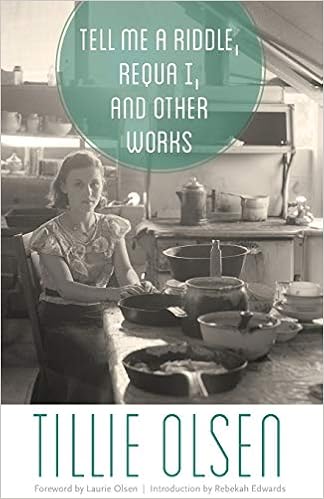 A century after her birth, Tillie Olsen’s writing is as relevant as when it first appeared; indeed, the clarity and passion of her vision and style have, if anything, become even more striking over time. Collected here for the first time are several of Olsen’s nonfiction pieces about the 1930s, early journalism pieces, and short fiction, including the four beautifully crafted, highly celebrated stories originally published as TELL ME A RIDDLE: “I Stand Here Ironing,” “Hey Sailor, What Ship?,” “O Yes,” and “Tell Me a Riddle.” Also included, for the first time since it appeared in the 1971 Best American Short Stories, is “Requa I.”
 Sixteen-year-old Odile Ozanne is an awkward, quiet girl, vying for a coveted seat on the Conseil. If she earns the position, she’ll decree who among the town’s residents may be escorted deep into the woods, who may cross the border’s barbed wire fence, who may make the arduous trek to descend into the next valley over. It’s the same valley, the same town. But to the east, the town is twenty years ahead in time. To the west, it’s twenty years behind. The only border crossings permitted by the Conseil are mourning tours: furtive viewings of the dead in towns where the dead are still alive.
 YONNONDIO follows the heartbreaking path of the Holbrook family in the late 1920s and the Great Depression as they move from the coal mines of Wyoming to a tenant farm in western Nebraska, ending up finally on the kill floors of the slaughterhouses and in the wretched neighborhoods of the poor in Omaha, Nebraska.