
The deeply researched and definitive account of the invisible emotional work and mental load so often shouldered by women, and the economics of how it is devalued monetarily and socially, as it relates to the workplace, relationships, sex, family life, and much more – providing a new framework and language for a 21st-century feminism, and ideas for how to better share the load.
EMOTIONAL LABOR
by Rose Hackman
Flatiron/St. Martin’s Press, March 2023
 “Emotional labor.” The term might sound familiar, but what does it mean exactly? Originally used to describe the unacknowledged labor flight attendants did to make guests feel welcomed and safe—on top of their actual job description—the phrase has burst through to the national lexicon in recent years. The examples, whispered among friends and posted online, are endless—a woman is tasked with organizing family functions, even without volunteering; a stranger insists you “smile more,” even as you navigate a high stress environment or grating commute. Emotional labor is essential to our society and economy, but many are asked to perform this exhausting, draining work at no extra cost. In this ground-breaking, journalistic deep-dive, Rose Hackman traces the history of the term and exposes common manifestations of the phenomenon. She describes the many ways women and girls are forced to edit the expressions of their emotions to accommodate and elevate the emotions of others. But Hackman doesn’t simply diagnose a problem—she empowers us to combat patriarchy and forge pathways for radical evolution, justice and change. This is a must-have for any feminist reader.
Rose Hackman is a British journalist based in Detroit. Her work on gender, race, labor, policing, housing and the environment – published in the Guardian – has brought international attention to overlooked American policy issues, historically entrenched injustices, and complicated social mores.
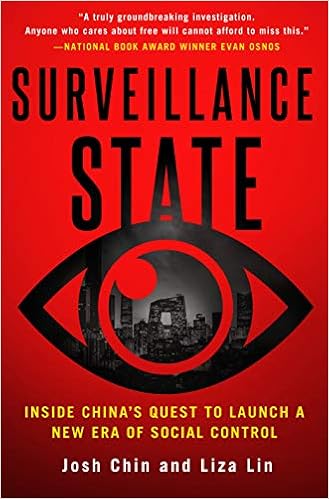 People living in democracies have for decades drawn comfort from the notion that their form of government, for all its flaws, is the best history has managed to produce. SURVEILLANCE STATE documents with startling detail how even as China’s Communist Party pays lip service to democracy as a core value of “socialism with Chinese characteristics,” it is striving for something new: a political model that shapes the will of the people not through the ballot box but through the sophisticated―and often brutal―harnessing of data.
 The Muungano empire strived and struggled to form a utopia when they split away from old earth. Freeing themselves from the endless wars and oppression of their home planet in order to shape their own futures and create a far-reaching coalition of city-states that stretched from Earth and Mars to Titan. With the wisdom of their ancestors, the leadership of their elders, the power and vision of their scientists and warriors they charted a course to a better future. But the old powers could not allow them to thrive and have now set in motion new plots to destroy all that they’ve built. In the fire to come they will face down their greatest struggle yet. Amachi Adisa and other young leaders will contend with each other for the power to galvanize their people and chart the next course for the empire. Fela Buhari and her elite unit will take the fight to regions not seen by human eyes, but no training will be enough to bring them all home. Stacia Chikeke, captain of the starship
  Four years ago, five kids started a game. Only four survived. Now, at the end of their senior year of high school, the survivors—Dax, Maddy, Emerson, and Owen—have reunited for one strange and terrible reason: they’ve been summoned by the ghost of Ian, the friend they left for dead. Together they return to the tunnel where their friendship ended with one goal: find Ian and bring him home. So they restart the deadly game they never finished—an innocent card-matching challenge called Meido. A game without instructions. As soon as they begin, they’re dragged out of their reality and into an eerie hellscape of Japanese underworlds, more horrifying than even the darkest folktales that Owen’s grandmother told him. There, they meet Shinigami, an old wise woman who explains the rules: They have one night to complete seven challenges or all of them, even Ian, will be stuck in this world forever. Once inseparable, the survivors now can’t stand each other, but the challenges demand they work together, think quickly, and make sacrifices—blood, clothes, secrets, memories, and worse. And once again, not everyone will make it out of Meido alive.
 It’s 1979, and Jasmine Zumideh is ready to get the heck out of her stale, Southern California suburb and into her dream school, NYU, where she’ll major in journalism and cover New York City’s exploding music scene. There’s just one teeny problem: Due to a deadline snafu, she maaaaaaybe said she was Senior Class President-Elect on her application―before the election takes place. But honestly, she’s running against Gerald Thomas, a rigid rule-follower whose platform includes reinstating a dress code―there’s no way she can lose. And she better not, or NYU will rescind her application. But then, an international incident turns the election upside down: a group of students in Iran, fed up with the U.S.’s interference in Iranian politics, takes the American Embassy in Tehran―and the people within it―hostage. And, as the Iran Hostage Crisis dominates the nightly news, her opponent seizes the opportunity to stir up anti-Iranian sentiment at school and turn the electorate against her―with the help of her outspoken brother, who never stops talking about it. Now, as the white lie she told snowballs into an avalanche, Jasmine is stuck between claiming her heritage or hiding it, standing by her outspoken brother or turning her back on him, winning the election or abandoning her dreams for good.