
In this enthralling historical epic, set in New York City and the Middle East in the years leading to World War I— the long-awaited follow-up to the acclaimed New York Times bestseller The Golem and the Jinni—Helene Wecker revisits her beloved characters Chava and Ahmad as they confront unexpected new challenges in a rapidly changing human world.
THE HIDDEN PALACE:
A Tale of the Golem and the Jinni
by Helene Wecker
HarperCollins, June 2021
(chez Frances Goldin Literary Agency – voir catalogue)
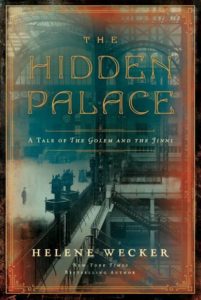 Chava is a golem, a woman made of clay, able to hear the thoughts and longings of the humans around her, and compelled to help them. Ahmad is a jinni, a being of fire now imprisoned in the shape of a man, perpetually restless and free-spirited. Having met as two unlikely immigrants in 1899 Manhattan, their lives have become deeply intertwined, but they must decide what, exactly, they mean to each other—all while living disguised as humans, constantly fearing they’ll be exposed as monsters. Meanwhile, Park Avenue heiress Sophia Winston, whose brief encounter with Ahmad has left her with a strange illness that makes her shiver with cold, travels to the Middle East to seek a cure. There she meets a tempestuous female jinni who’s been banished from her tribe for her own untreatable condition. And in a tenement on the Lower East Side, a little girl named Kreindel helps her rabbi father build a golem that she names Yossele. When she is sent to an uptown orphanage, the hulking golem will become her only friend and companion. Spanning the tumultuous years from the turn of the 20th century to the beginning of World War I, THE HIDDEN PALACE follows these lives and others as they collide and interleave. Can Chava and Ahmad find their places in the human world while remaining true to each other? Or will their own natures and desires conspire to tear them apart—especially once they encounter, thrillingly, other creatures of their own kinds?
Helene Wecker grew up in Libertyville, Illinois, a small town north of Chicago, and received her Bachelor’s in English from Carleton College in Minnesota. After graduating, she worked a number of marketing and communications jobs in Minneapolis and Seattle before deciding to return to her first love, fiction writing. She received her MFA in fiction from Columbia University. She now lives near San Francisco with her husband and two children.
 Paris, ca. 1850. Bed-ridden and terminally ill, Heinrich Heine wants to prise one final work from the jaws of death: His memoirs are to be his magnum opus. It’s been a long time since he last attended an illustrious bohemian dinner – instead, he receives occasional visits from German exiles and French artist friends. One day, Elise Krinitz seeks him out. The young woman admires Heine, and hopes to find in him a mentor for her own literary ambitions. He tenderly and ironically calls her ‘Mouche’, and they soon embark on a platonic, but nonetheless passionate affair. Yet when Heine dies on the 17th February 1856, his memoirs are lost forever. Steeped in the fascinating panorama of 1850s Paris, Boëtius’s novel is a unique portrait of the final years of the great German poet Heinrich Heine.
 Over the centuries, unbeknownst to all, a small clan of spies has worked ceaselessly to fight oppression. They are called the Tabula Rasa. They can pass unseen through enemy lines, eavesdrop on conversations, and « become » other people without being recognized. They are, essentially, faceless. Alice and Louise Winfield are sisters and spies in the Tabula Rasa. They’re growing up in war-time England, where the threat of Nazi occupation is ever near. But Louise wants to live an ordinary life, and she tires of spy missions. When she leaves the agency, Alice must face her most dangerous assignment yet, without her sister at her side. As Alice prepares for her new mission, she must head into Hitler’s inner sanctum in Germany to report on the Nazis. She fears the threat of discovery, but, worst of all, she fears losing her own sister. This novel is a mix of espionage and historical adventure. Lasky masterfully spins a tale filled with mystery, suspense and intrigue.
 1860, Louisiana. After serving as mistress of Le Petit Cottage for more than six decades, Madame Sylvie Guilberthas decided, in spite of her family’s indifference, to sit for a portrait—a testament to all the hardships she has overcome, and the glory that her life ought to have had. But there are other important stories to be told on the Guilbert plantation. Like that of Thisbe, the young enslaved woman who must stand silent by her mistress, but who observes everything. Or Byron, the heir to the plantation, whose desires cannot possibly fit with his family duty. Stories that span generations, from the big house to out in the fields, of routine horrors, secrets buried as deep as the family fortune, and a tangled lineage of descendants and dependents who have never forgotten who they are.
 Katharina Edgeworth seems to have the perfect life. She is the daughter of immigrants, Ivy-League-educated, and speaks four languages. As a single girl in 1940s Manhattan, she is employed as a translator at the newly formed United Nations, devoting her days to her work and the promise of world peace—and her nights to cocktails and the promise of a good time. Now, in 1954 Katharina has the ideal husband, two healthy sons, and enjoys the luxuries of Fifth Avenue; but she is desperate to break free from the constraints of domesticity before depression breaks her for good. When the FBI approaches her to become an informant, Katharina seizes the opportunity. A man from her past has become a high-level Soviet spy, but no one has been able to infiltrate his circle. Enter Katharina, the perfect woman for the job. Navigating the demands of the FBI and the secrets of the KGB, she becomes a courier, carrying stolen government documents from Washington D.C. to Manhattan. But as those closest to her lose their covers, and their lives, Katharina’s secret—which fills her with purpose and reignites her self-worth––soon threatens to ruin her. With the fast-paced twists of a classic spy thriller, a celebration of post-war New York City, and a nuanced depiction of the complexity of motherhood, A WOMAN OF INTELLIGENCE shimmers with Tanabe’s trademark acerbic wit, attention to historical detail, and sharp understanding of human desire.