
Lush and uncompromising stories about characters crossing geographical borders and gender binaries.
MANYWHERE: Stories
by Morgan Thomas
mcd/Farrar, Straus & Giroux, January 2022
(via Defiore & Company)
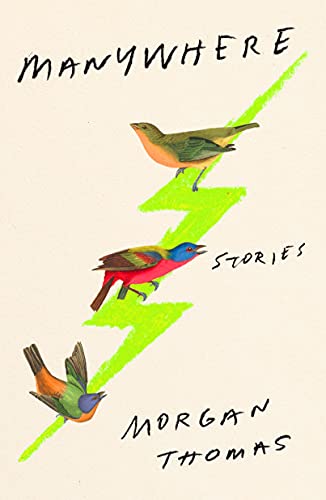 The nine stories in Morgan Thomas’s shimmering debut collection MANYWHERE witness Southern queer and genderqueer characters determined to find themselves reflected in the annals of history, at whatever cost. As each character traces deceit and violence through tall tales and their own pasts, their journeys reveal the porous boundaries of body, land, and history, and the sometimes ruthless awakenings of self-discovery.
A trans woman finds her independence through the purchase of a pregnancy bump. A young Virginian flees their relationship, choosing instead to immerse themselves in the life of an intersex person from colonial-era Jamestown. A young writer tries to evade the murky and violent legacy of an ancestor, who supposedly disappeared into a midwifery bag. And in the uncanny title story, a young trans person brings home a replacement daughter for their elderly father.
Winding between reinvention and remembrance, transition and transcendence, these origin stories rebound across centuries. With warm, meticulous emotional intelligence, Morgan Thomas’s MANYWHERE uncovers how the stories we borrow to understand ourselves in turn shape the people we become. Ushering in a new form of queer mythmaking, MANYWHERE introduces a storyteller of uncommon range and talent.
Morgan Thomas’s work has appeared or is forthcoming in The Atlantic, The Kenyon Review, American Short Fiction, VICE, Joyland, Electric Literature, Ploughshares, them., and StoryQuarterly, where their story won the 2019 Fiction Prize. They are the recipient of a Bread Loaf Work-Study Grant, a Fullbright Grant, the Penny Wilkes Scholarship in Writing and the Environment, and the winner of the inaugural Southern Studies Fellowship in Arts and Letters. They have also received fellowships from the Sewanee Writers’ Conference, the Millay Colony for the Arts, and the Arctic Circle. A graduate of the University of Oregon MFA program, they live in Portland.
 On an early-April dawn in 2003, in a Portland hospital far from the Rummani family’s ancestral home in Palestine, a stillborn baby girl comes back to life and turns a vibrant cobalt blue. On the same day, the Rumanni’s beloved soap factory in Nablus is destroyed in a bombing. To Nuha, the girl’s great-aunt, there’s no question that this inexplicable child somehow embodies their sacred family history, when the Rummanis were among the wealthiest soap-makers and their blue soap was a symbol of a famous, unlikely love.
 In the vein of Carmen Maria Machado, Kelly Link, and Daniel Lavery, and born of the author’s experience in and between genders, these stories blur the line between fantasy and reality, between the lives we wish for and the ones we actually lead, excavating new meanings from our varied dysphorias. Ranging from a tornado survivor grappling with a new identity, to a trans teen psychic that can only read undecided minds, from a woman telling her family of her plans to upload her consciousness and abandon her body, to con artists, runaways, and lost souls returning home, Blue’s characters all share an insistence on forging their own realities. Surreal, darkly funny, and always tender, PRETEND IT’S MY BODY is a collection bound together by the act of searching – for a story of one’s own, for a glimpse of certainty, and for a spark of recognition in others.
 A powerful, heart-warming novel sharing the embarrassments and excitements, horrors and humiliations, glories and defeats of a group of twenty-something year-olds, navigating life, love, sex and their dreams. Trying to appear ordinary on the outside but inside obsessing on the unspoken rules of what’s okay and racked with self-doubt.
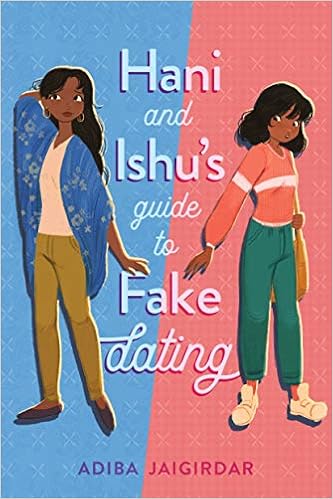 Everyone likes Hani Kahn—she’s easy going and one of the most popular girls at school. But when she comes out to her friends as bisexual, they invalidate her identity, saying she can’t be bi if she’s only dated guys. Panicked, Hani blurts out that she’s in a relationship…with a girl her friends absolutely hate—Ishita Dey. Ishita is the complete opposite of Hani. She’s an academic overachiever who hopes that becoming head girl will set her on the right track for college. But Ishita agrees to help Hani, if Hani will help her become more popular so that she stands a chance of being elected head girl. Despite their mutually beneficial pact, they start developing real feelings for each other. But relationships are complicated, and some people will do anything to stop two Bengali girls from achieving happily ever after.