
Why do people not want to be happy? And how can it be that only a machine can find the true path to happiness? For all readers of Graeme Simsion’s The Rosie Project and Ian McEwan’s Machines Like Me.
DER ALGORITHMUS DER MENSCHLICHKEIT
(The Algorithm of Humanity)
by Vera Buck
Limes/PRH Germany, March 2021
 If you meet Mari, you will notice that she is beautiful and almost hauntingly perfect. But also that she fails to get jokes and vies everything rationally. And if you get to know her better, you will notice that Mari needs neither sleep nor food. Because Mari is only almost human. Her artificial intelligence is constantly learning to do one job: to make people happy. When Mari ends up in a Berlin apartment after an unfortunate chain of circumstances with a motley crew of people, including the rebellious blogger Frieda and the lonely student Linus, she realizes that her mission is all but easy. The world follows its own logic, people’s desires are irrational and Mari has to understand that there exists a world beyond provable facts. How is she supposed to make beings happy that have no clue what they want? She comes up with a solution no human would have ever expected… DER ALGORITHMUS DER MENSCHLICHKEIT deals with questions that are becoming incredibly important in the current developments in the technology sector: What makes us human? Why do we need each other? And why do we actually need more of each other, and less of the new technologies that are constantly being developed?
Vera Buck, born in 1986, studied journalism in Hannover and scriptwriting on Hawaii. During this time she wrote texts for radio, television and print media and later short stories for anthologies and literary magazines. After working at universities in France, Spain and Italy, Vera Buck now lives and works in Zürich.
 Through the lens of its patriarch, THE FAMILY IZQUIERDO deftly weaves together the lives of different members of the Izquierdo clan to paint the picture of a Mexican-American family bound together by love, and a curse. From young love to a failing marriage, from a mother afraid to leave her house to a young woman moving far from her family to try to find her way, Papa Tavo watches as his children and grandchildren try to navigate their way through a confusing and painful world. But it’s hard when a neighbor’s black magic hechizos affect their ability to live their lives.
 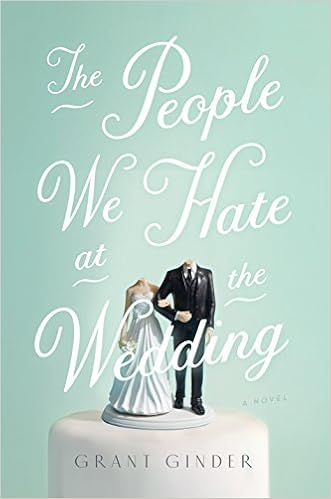 La société de production FilmNation prépare une adaptation long-métrage du roman THE PEOPLE WE HATE AT THE WEDDING de Grant Ginder. Cette comédie, décrite comme le Quatre mariages et un enterrement de la nouvelle génération, sera réalisée par Claire Scanlon (Unbreakable Kimmy Schmidt, The Good Place, Brooklyn Nine-Nine, Glow…). Sont pressentis pour les rôles principaux : Allison Janney (La Couleur des sentiments, Juno, The Hours, Hairspray, Moi, Tonya…), Annie Murphy (Schitt’s Creek) et Ben Platt (Pitch Perfect, Cher Evan Hansen). Aucune date de sortie n’a été annoncée pour le moment. (Lire l’
 Une minisérie adaptée du roman MOTHER DAUGHTER WIDOW WIFE de Robin Wasserman est en développement aux studios Sony Pictures Television. Elle sera produite par Sharon Hall (Breaking Bad, Masters of Sex, Justified, Damages, The Expanse…) et c’est l’auteure elle-même qui travaillera sur le scénario. La date de sortie n’a pas encore été annoncée. (Lire l’
 MOTHER DAUGHTER WIDOW WIFE est centré autour de la mystérieuse « Wendy Doe », femme amnésique retrouvée dans un bus sans papiers d’identité, et des personnages qui gravitent autour d’elle : Dr Strauss, le célèbre psychiatre qui étudie son cas, Lizzie, la chercheuse qui travaille avec lui, et plus tard Alice, la fille de Wendy. En quête d’informations sur sa mère disparue, cette dernière va contribuer à mettre au jour le sombre secret du Dr Strauss et son rôle dans la vie des trois femmes…
 Sisters Helen and Lutie moved to Denver from Iowa after their parents died. Helen, the oldest and a nurse, and Lutie, a carefree advertising designer, share a small, neat house and make a modest income from a rental apartment in the basement. But when their tenant dies from the flu, Helen and Lutie are thrust into much more than a sad family drama. There is no safe place for a wayward child in the midst of the epidemic, so the sisters are forced to take in the woman’s small daughter. Dorothy is a shy girl who tries to hide the bruises on her body and who shuts down at any mention of her absent father. They shower her with kindness and love and the three soon feel like a new family, albeit a temporary one. But then everything shatters. Lutie comes home from work and discovers a dead man on their kitchen floor and Helen standing above the body with an icepick in hand. Lutie has no doubt Helen killed the man—Dorothy’s father—defending herself or the little girl, but she knows that will be hard to prove. So when Helen’s doctor boyfriend arrives, a pact is made to protect the nurse at all costs. And this will not be the only secret they have to keep as the war and the flu knock relentlessly on their door.