
In his New York Times bestselling book The End of Power, Moises Naim examined power-diluting forces. Now, in THE REVENGE OF POWER, Naim turns to the trends, conditions, and behaviors that are contributing to the concentration and augmentation of power and to the clash between the forces that weaken power and those that strengthen it.
THE REVENGE OF POWER:
The Global Assault on Democracy and How to Defeat It
by Moisés Naím
St. Martin’s Press, February 2022
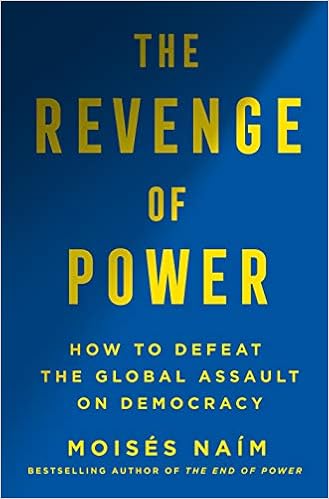 Moisés Naím concentrates on the three “P”s—populism, polarization, and post-truths. Using the best available data and insights taken from recent research in the social sciences, Naim reveals how the same set of strategies to consolidate power pop up again and again in places with vastly different political, economic, and social circumstances. The outcomes of these battles for power will determine if our future will be more autocratic or more democratic. These outcomes will, in turn, depend on the capacity of our democracies to survive the attacks and dirty tricks of autocratic leaders bent on weakening the checks and balances that limit their power. Naim addresses the questions at the heart of the matter: What are, in practice, those attacks and tricks? Why is power concentrating in some places while in others it is fragmenting and degrading? And the big question: what is the future of freedom?
Moisés Naím is a scholar at the Carnegie Endowment for International Peace and an internationally syndicated columnist. For over a decade he was the editor-in-chief of Foreign Policy magazine and under his leadership, the magazine was re-launched, won the National Magazine award for General Excellence three times and became one of the world’s most influential publications in international affairs. Naím also served as Venezuela’s Minister of Industry and Trade and as executive director of the World Bank. He holds a PhD from MIT and lives in Washington, DC.
 The Rolling Stones have long been considered one of the greatest rock-and-roll bands of all time. At the forefront of the British Invasion and heading up the counterculture movement of the 1960s, the Stones’ innovative music and iconic performances defined a generation, and fifty years later, they’re still performing to sold-out stadiums around the globe. Yet, as the saying goes, behind every great man is a greater woman, and behind these larger-than-life rockstars were four incredible women whose stories have yet to be fully unpacked. . . until now.
 The COVID-19 crisis is the greatest shock to the world order since World War II. Millions have been infected and killed. The economic crash caused by the pandemic is the worst since the Great Depression, with the International Monetary Fund estimating that it will cost over $9 trillion of global wealth in the next few years. Many will be left impoverished and hungry. Fragile states will be further hollowed out, creating conditions ripe for conflict and mass displacement. Meanwhile, international institutions and alliances already under strain before the pandemic are teetering, while the United States and China, already at loggerheads before the crisis, are careening toward a new Cold War. China’s secrecy and assertiveness have shattered hopes that it will become a responsible stakeholder in the international order.
 For an entire generation, at home and abroad, the United States has waged an endless conflict known as the War on Terror. In addition to multiple ground wars, it has pioneered drone strikes and industrial-scale digital surveillance, as well as detaining people indefinitely and torturing them. These conflicts have yielded neither peace nor victory, but they have transformed America. What began as the persecution of Muslims and immigrants has become a normalized, paranoid feature of American politics and security, expanding the possibilities for applying similar or worse measures against other targets at home. A politically divided country turned the War on Terror into a cultural and then tribal struggle, first on the ideological fringes and ultimately expanding to conquer the Republican Party, often with the timid acquiescence of the Democratic Party. Today’s nativist resurgence walked through a door opened by the 9/11 era.
 Raquel Willis is a powerful woman. But growing up as a young boy in the South made being herself almost impossible. In this moving and provocative memoir, Raquel relives the many risks she faced in her struggle to become a fierce advocate for her community—and the powerful woman—that she is today. Today, she is known as a transgender trailblazer, both for work with the Transgender Law Center and speaker at the National Women’s March. She offers intimate reflections on masculinity and blackness, informed by a tumultuous relationship with her father. From a childhood built in opposition to expectations, all the way through her transition at a flagship Southern university, Raquel demonstrates that her story is but one thread in the larger tapestry of Black trans American life; a tapestry that has never truly been chronicled from this millennial, Southern perspective.