
Archives de catégorie : Nonfiction

SUPER NINTENDO de Keza MacDonald

The first major cultural history of the biggest form of entertainment on the planet– video games – by the world’s pre-eminent video games journalist, with unique never-before-granted access to Nintendo HQ.

SUPER NINTENDO:
How One Innovative Japanese Company Helped the World Have Fun
by Keza MacDonald
Faber, summer 2025
(via Randle Editorial & Literary)

Whether it’s Mario or Animal Crossing; Tetris on the Game Boy or The Legend of Zelda on the Switch; almost everybody who’s ever held a controller has been touched by a Nintendo game.

For most of its 130-year history, Nintendo, the Kyoto-based entertainment giant, made playing cards. But in 1981, after a few years experimenting in the burgeoning world of electronic toys, it created an arcade game called Donkey Kong. Since then, Nintendo has delighted hundreds of millions of people all over the world with their fizzily creative, brilliantly weird, and enormously fun video games, that issue forth from its secretive Japanese headquarters.

Nintendo is now as ubiquitous and culturally relevant as Marvel, Apple or Disney. Like Disney, it has become a cross-generational treasure, as the kids who were captivated by Super Mario Bros on the SNES now play Nintendo classics with their own children, and proud parents who once doodled pictures of Pikachu on their class notebooks chaperone their offspring to the Pokémon World Championships.

A lot has changed since 1981, but kids still know who Mario is.

Using Nintendo’s most iconic and recognisable games (alongside a smattering of fascinating but less-well-known ones) as a way in, SUPER NINTENDO will tell both a cultural history of video games and posit a narrative about how fun is our primary desire when we consume media.

Taking readers through Nintendo’s history – as so through the history of the medium itself – it will tell the stories of some of the millions of people whose lives have been touched not only by Nintendo games, but gaming more generally: from real-life Pokémon masters to video game developers, parents of autistic children to ordinary players on the sofa, the bus, or the school playground.

Using the story of Nintendo, and its games, to examine how and why the world has moved toward video games as its pre-eminent form of fun, SUPER NINTENDO is the first book to truly examine the dominant cultural medium of the 21st century.

Keza MacDonald played her first Nintendo game at the age of 6; when she was 11, her dream was to go to the Pokémon World Championships. (She finally achieved this aged 25. It was magical.) She is the Video Games Editor at The Guardian, and was previously UK Editor of IGN and Kotaku, two of the biggest specialist games websites in the world, read by over 100 million unique users. She lives in Glasgow, Scotland, with her husband and two sons.

THE BRIGHT SIDE de Sumit Paul-Choudhury


In the bestselling tradition of Steven Pinker’s Enlightenment Now and Yuval Noah Harari’s Homo Deus, an engaging and interdisciplinary look at the history, philosophy, and psychology of optimism, and why being optimistic is a moral obligation—even in the face of seemingly insurmountable challenges.

THE BRIGHT SIDE:
Why Optimists Have the Power to Change the World
by Sumit Paul-Choudhury
Canongate, January 2025
(via Randle Editorial & Literary)

Scrolling through our daily newsfeeds we see war, political unrest, the swift rise of artificial intelligence, and a looming climate crisis – just a few of the tragedies fostering pessimism. So, in the face of such glum events, how do we stay optimistic? And, more important, why should we?
In THE BRIGHT SIDE, Sumit Paul-Choudhury tackles these pressing questions, arguing that optimism is not only essential for overcoming the obstacles ahead but also fundamental to human resilience and progress. Drawing on a wide array of evidence across diverse fields, Paul-Choudhury delves into the underappreciated philosophical roots of optimism, examines its impact on mental health and professional success, and discusses how an optimistic outlook supports a scientific and rational world view.

Beyond theoretical discussions, THE BRIGHT SIDE shows how we can apply the principles of optimism to address complex challenges, particularly the environmental crisis. Through visits to innovative projects like the futuristic LINE city in Saudi Arabia, the Faslane Peace Camp in Scotland, initiatives related to the New Green Deal, and anecdotes covering everything from Ernest Shackleton to Bitcoin mania, the book illustrates optimism in action.

A salve for dark times, THE BRIGHT SIDE is a lens through which we can identify and solve the problems we face and create a better future for ourselves and generations to come.

“An expansive tour de force that … helps readers understand what drives us to imbue ourselves with optimism and how to use it to create a better future. Paul-Choudhury’s own voice shines through – he is witty, empathetic and a beautiful writer… We’re born optimists, Paul-Choudhury argues; if you’re no longer one, this title will give you a way back – and a lot more besides.” — The Observer

Sumit Paul-Choudhury writes, thinks, and dreams about science, technology, and the future. He is the former Editor-in-Chief of New Scientist, a trained astrophysicist, and a former business journalist covering financial engineering and technology. Currently, he devotes most of his time to his creative studio Alternity, developing speculative histories and social experiments. A Sloan Fellow at London Business School and a Fellow of the Royal Society of Arts, he lives, works, and problem solves in London with his wife and young twins.

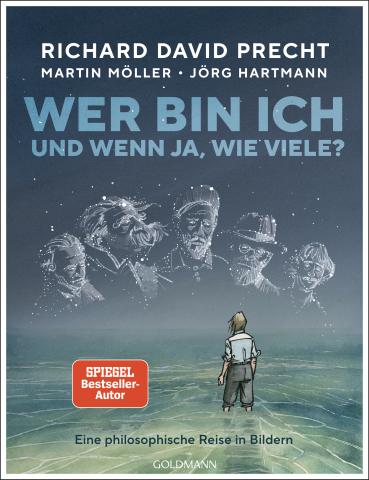
WER BIN ICH – UND WENN JA, WIE VIELE? DIE GRAPHIC NOVEL de Richard David Precht, Martin Möller et Jörg Hartmann

The graphic novel of the bestselling book by Germany’s most famous living philosopher, for readers of Sapiens by Yuval Noah Harari and Sophie’s World by Jostein Gaarder.

WER BIN ICH – UND WENN JA, WIE VIELE? DIE GRAPHIC NOVEL
(Who Am I – And If Yes, How Many? The Graphic Novel)
by Richard David Precht & Martin Möller
illustrated by Jörg Hartmann
Goldmann/PRH Germany, Septembre 2024

Precht’s « Who Am I – And If Yes, How Many? » introduced millions of readers to the big philosophical questions of our time, making him one of Germany’s most famous authors. A good fifteen years later, it is being published again – this time as a graphic novel. Illustrated by Jörg Hartmann, it gives us Precht’s wisdom inside a modern aesthetic. Everything we know about ourselves from neuroscience, psychology and philosophy is contained within its pages – creating a unique path through the plainly mind-boggling amount of information out there about what it means to be human.
Richard David Precht, born in 1964, is a philosopher, journalist, and author, and one of the most distinguished intellectuals in the German-speaking countries. He is an honorary professor of philosophy and aesthetics at the Hanns Eisler Academy of Music in Berlin. Ever since his sensational success with Who Am I – And If Yes, How Many?, his books about philosophy and society have been consistent bestsellers, and they have been translated into 40 languages. Since 2012 he has presented the philosophy programme Precht on the TV channel ZDF, and he discusses social, political and philosophical issues with Markus Lanz on the weekly hit podcast Lanz & Precht.

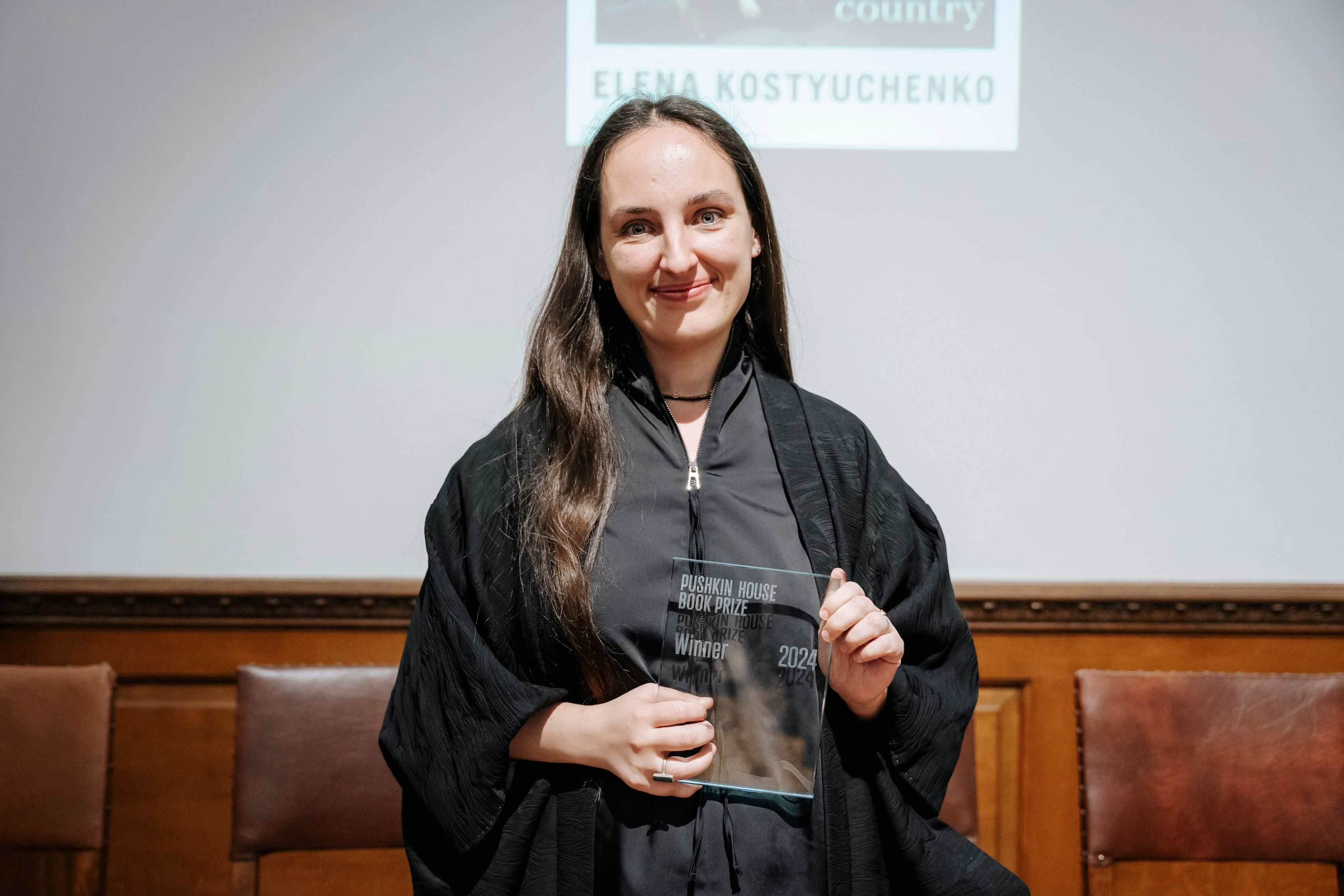
Elena Kostioutchenko remporte le Pushkin House Book Prize 2024

Photo credit: Rocio Chacon

Elena Kostioutchenko s’est vu décerner le Pushkin House Book Prize 2024, qui lui a été remis à Londres le 14 juin dernier en présence de l’une de ses traductrices et de son éditeur britannique.

La Pushkin House est un espace artistique, culturel et social situé à Londres qui explore, remet en question et débat de la culture et de l’identité russes aujourd’hui. Le Pushkin House Book Prize a été créé en 2013 afin de récompenser et d’attirer l’attention sur les ouvrages de non-fiction provenant de Russie ou portant sur ce pays, écrits ou traduits en anglais. Les sujets des livres sélectionnés ne concernent pas seulement la vie et la culture à l’intérieur des frontières de l’actuelle Fédération de Russie, mais aussi l’expérience de ceux dont les terres natales ont été affectées par l’Empire russe et l’Union soviétique.

Les éditions Noir sur blanc ont publié l’édition française, intitulée RUSSIE, MON PAYS BIEN-AIME, en février 2024 dans une traduction d’Emma Lavigne et Anne-Marie Tatsis-Botton.

« Être journaliste, c’est dire la vérité. Avec Mon pays bien-aimé, Elena Kostioutchenko documente son pays, tel qu’il est vécu par celles et ceux qu’il efface systématiquement, par exemple les filles de la campagne recrutées comme travailleuses du sexe, les personnes queer des provinces éloignées, les patientes et les médecins d’une maternité ukrainienne – et les journalistes, dont elle fait partie.
Cet ouvrage est le portrait singulier d’une nation, et celui d’une jeune femme qui refuse de garder le silence. En mars 2022, alors qu’elle est reporter pour Novaïa Gazeta, l’un des derniers journaux russes indépendants, Kostioutchenko se rend en Ukraine pour couvrir la guerre. Elle se donne pour mission d’informer les Russes sur les horreurs que Poutine commet en leur nom. Elle sait dès le début que si elle retourne dans son pays, elle risque d’être condamnée à quinze ans de prison, sinon pire. Portée par la conviction que la plus grande forme d’amour et de patriotisme est la critique, elle continue à écrire, nullement découragée, les yeux grand ouverts. »

Le Prix allemand de la non-fiction 2024 décerné à Christina Morina

L’historienne Christina Morina a reçu le 11 juin le Prix allemand de la non-fiction 2024 (Deutscher Sachbuchpreis 2024) pour son ouvrage TAUSEND AUFBRÜCHE (« Mille nouveaux départs. Les Allemands et la démocratie depuis les années 1980 »). Le livre avait déjà été sélectionné pour le Prix de la foire du livre de Leipzig de cette année.

Voici le commentaire du jury :

« Tout le monde s’accorde à dire que les démocraties sont en crise dans le monde entier. Mais la question de savoir ce que signifie réellement vivre la démocratie est souvent reléguée au second plan. Christina Morina utilise des sources peu considérées jusqu’à présent pour montrer à quel point la conception de la démocratie a évolué différemment en Allemagne de l’Est et de l’Ouest depuis les années 1980. Son analyse de l’histoire contemporaine, très instructive et raffinée sur le plan méthodologique, se base sur des lettres, des pétitions et des tracts et donne une voix aux citoyens et citoyennes de la RDA et de la RFA. Avec ce livre, Christina Morina donne des impulsions surprenantes et nécessaires aux discussions sociales actuelles. Son livre prend beaucoup de risques sans polariser ; la démocratie est un processus, pas un état. »

Le Prix allemand de la non-fiction est décerné chaque année à un ouvrage exceptionnel de non-fiction publié en langue allemande qui stimule le débat social. Il est doté d’une récompense de 25 000 euros. Depuis le début du concours, les sept membres du jury ont examiné 225 titres publiés depuis avril 2023.

Christina Morina est professeure d’histoire contemporaine à l’Université de Bielefeld en Allemagne. Ses recherches portent sur l’histoire sociale et mémorielle du nazisme, sur l’histoire politique et culturelle de l’Allemagne divisée et réunifiée ainsi que sur la relation entre l’histoire et la mémoire. Elle a étudié l’histoire, les sciences politiques et le journalisme aux universités de Leipzig, de l’Ohio et du Maryland et a obtenu son doctorat en 2007.

Les droits de langue française sont toujours disponibles.