
From an experienced financial journalist, the story of how women have fought for financial freedom, and the social and political hurdles that have keep them from equality.
WOMEN MONEY POWER
The Rise and Fall of Economic Equality
by Josie Cox
Abrams, March 2024
 For centuries, women were denied equal access to money and the freedom and power that came with it. They were restricted from owning property or transacting in real estate. Even well into the 20th century, women could not take out their own loans or own bank accounts without their husband’s permission. They could be fired for getting married or pregnant, and if they still had a job, they could be kept from certain roles, restricted from working longer hours, and paid less than men for equal work.
It was a raw deal, and women weren’t happy with it. So they pushed back. In WOMEN MONEY POWER, financial journalist Josie Cox tells the story of women’s fight for financial freedom. This is an inspirational account of brave pioneers who took on social mores and the law, including the “Rosies” who filled industrial jobs vacated by men and helped win WWII, the heiress whose fortune helped create the birth control pill, the brassy investor who broke into the boys’ club of the New York Stock Exchange, and the namesake of landmark equal pay legislation who refused to accept discrimination.
But as any woman can tell you, the battle for equality—for money and power—is far from over. Cox delves deep into the challenges women face today and the culture and systems that hold them back. This is a fascinating narrative account of progress, women’s lives, and the work still to be done.
Josie Cox is a journalist, editor, and broadcaster with a particular interest in business, workplace culture, and equality. She has an extensive professional network and experience working for a broad range of media outlets in Germany, Switzerland, the UK, and the US, including Reuters, The Wall Street Journal, and The Independent, where she served as business editor. As a freelancer, her work has appeared in The Guardian, Fortune, Forbes, The Times and Sunday Times of London, and other publications. She has appeared as a commentator on CNN, Fox News, Al Jazeera, and Sky News, and is a regular guest on the BBC. Cox was a fully funded 2020/2021 Knight–Bagehot Fellow at Columbia Journalism School. She has an MBA from Columbia Business School and is also an associate instructor within the Strategic Communications program at Columbia’s School of Professional Studies. She lives in New York City.
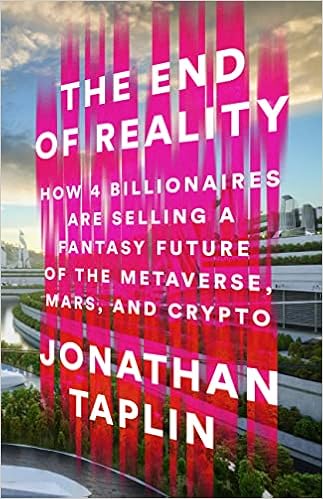 At a time when the crises of income inequality, climate, and democracy are compounding to create epic wealth disparity and the prospect of a second American civil war, four billionaires are hyping schemes that are designed to divert our attention away from issues that really matter. Each scheme—the metaverse, cryptocurrency, space travel, and transhumanism—is an existential threat in moral, political, and economic terms.
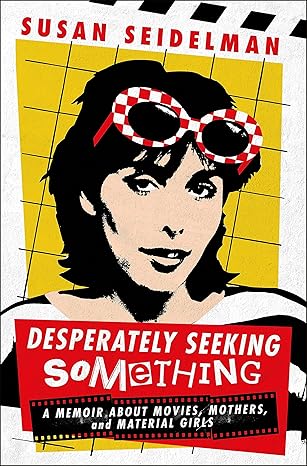 In the early 1970s, Susan Seidelman left the ordinary suburb in which she was raised and moved to New York City to become someone different. The city was bankrupt, crumbling, cheap… and the Lower East Side was evolving into a creative playground for artists and misfits looking to reinvent themselves. There, Seidelman would break boundaries: first as an award winning independent film director of Smithereens (the first independent film nominated at the Cannes Film Festival), then as a much sought after studio director when Hollywood was still run as an all-boys club. Her work would become an important part of the zeitgeist that influenced the music, fashion, and pop culture of America in the 1980s and 90s as she unapologetically challenged the male gaze that permeated most movies of that time.
 A leading scholar of artificial intelligence explores the ways in which AI is shaping contemporary culture: how it will change our lives, for better and for worse, and what it means to live in this crucial, watershed moment. The book will be structured around five parts, each centered on a basic ingredient of human creation: Words, Images, Sounds, Motion, and Systems. The chapters contend with how each element is transformed by AI systems, and how the industries that depend upon it are changing, Asking what does this mean for us, as individuals and as a society, Professor Crawford posits that the best way to understand the cultural metamorphosis underway is to start with how AI makes things for us, and what we are making of it. In this way, the book speaks to changes at the foundational level of human creation, as well as addressing a dramatic series of simultaneous industrial shifts.
 The Ocean Race is the toughest team race in the sailing calendar. It consists of seven legs that take around six months to complete, the longest of which covers an unbelievable 23,000 km, from Cape Town via Cape Horn to Itajaí in Brazil. German champion yachtsman Boris Herrmann and Team Malizia are competing against four other teams on Seaexplorer, and with five crew squeezed into such a small space you need to be able to rely on each other. In storms and lulls, everything you do has to be exactly right. Unforeseen problems like a crack on a mast 26 m up could spell the end of the race for the Seaexplorer, but the team tackles them with total professionalism. These four men and one woman are pushing their bodies and minds to the very limit, as they experience both failures and triumphs. In their new book, Herrmann and Wolfers give us a fascinating insight into the Ocean Race, and what it’s like for five people to live and work together in such exciting and unique circumstances.