“The four pieces in TELL ME A RIDDLE are lyrical bulletins of working-class family life, charged with emotional detail and delivered with an attention to the rhythms of consciousness more rigorous and powerful than most of what is called realism.” –A.O. Scott, New York Times
TELL ME A RIDDLE, REQUA I, AND OTHER WORKS
by Tillie Olsen
University of Nebraska Press, 2013
(via the Frances Goldin Literary Agency)
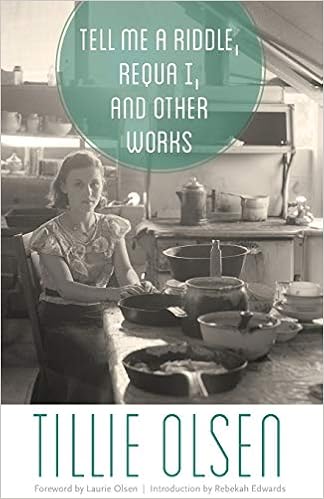 A century after her birth, Tillie Olsen’s writing is as relevant as when it first appeared; indeed, the clarity and passion of her vision and style have, if anything, become even more striking over time. Collected here for the first time are several of Olsen’s nonfiction pieces about the 1930s, early journalism pieces, and short fiction, including the four beautifully crafted, highly celebrated stories originally published as TELL ME A RIDDLE: “I Stand Here Ironing,” “Hey Sailor, What Ship?,” “O Yes,” and “Tell Me a Riddle.” Also included, for the first time since it appeared in the 1971 Best American Short Stories, is “Requa I.”
In these stories, as in all of her work, Olsen set a new standard for the treatment of women and the poor and for the depiction of their lives and circumstances. In her hands, the hard truths about motherhood and marriage, domestic life, labor, and political conviction found expression in language of such poetic intensity and depth that their influence continues to be felt today.
An introduction by Olsen’s granddaughter, the poet Rebekah Edwards, and a foreword by her daughter Laurie Olsen provide a personal and generational context for the author’s work.
Tillie Olsen, 1912-2007, is internationally renowned for her powerful writing about the inner lives of working-class families, women, and minorities. Her books, Tell Me a Riddle, Yonnondio from the Thirties, Silences, and her essays and lectures, have been translated into twelve languages. In April 2021, A.O. Scott, the critic at large and co-chief film critic for The New York Times, wrote about Tillie Olsen for his essay series on influential American authors, saying she “helped change the study of American literature, opening its canon to neglected voices and traditions.”
 YOUR BODY IS SMARTER THAN YOUR MIND couldn’t be more relevant or important as we increasingly rely on technology to give our brains key information. Do we really need a smartwatch to tell us how we slept? Your body tells you that when you wake up, we’ve just stopped listening. Instead, we’ve come to see our bodies as something we need to take care of, so that our minds can function and manage life. But our
  Offering an accessible and balanced analysis, WHY WE PLAY explores how video games have permeated our daily lives. Their presence in our homes, culture, business, politics, sport, education, and healthcare has made them one of the most ubiquitous mediums of modern times. The role games play today – from influencing youth culture to informing the design of space craft –renders them remarkably powerful. But as games occupy an increasingly important place in our daily lives, it’s becoming harder to understand the opportunities they offer and the challenges they present.
 After his sudden rise to power in the summer of 2019 amid the Brexit deadlock, Boris Johnson presided over the most dramatic period of British history in almost a century. From the controversial prorogation of Parliament in August 2019 to the Conservative party’s historic landslide victory later that year, the agonising upheaval of Brexit and the Covid-19 pandemic, the Afghanistan crisis, the conflict in Ukraine, and the series of devastating scandals that were ultimately Johnson’s undoing, his premiership has been more explosive than any other in living memory.