A heady, inventive, fantastical novel about the nature of memory and the difficulty of confronting trauma.
SUBDIVISION
by J. Robert Lennon
Graywolf Press, April 2021
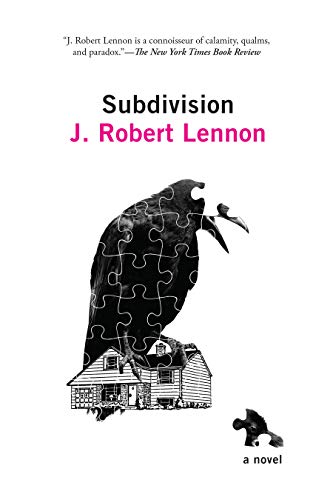 An unnamed woman checks into a guesthouse in a mysterious district known only as the Subdivision. The guesthouse’s owners, Clara and the Judge, are welcoming and helpful, if oddly preoccupied by the perpetually baffling jigsaw puzzle in the living room. With little more than a hand-drawn map and vague memories of her troubled past, the narrator ventures out in search of a job, an apartment, and a fresh start in life. Accompanied by an unusually assertive digital assistant named Cylvia, the narrator is drawn deeper into an increasingly strange, surreal, and threatening world, which reveals itself to her through a series of darkly comic encounters reminiscent of Gulliver’s Travels. A lovelorn truck driver…a mysterious child…a watchful crow. A cryptic birthday party. A baffling physics experiment in a defunct office tower where some calamity once happened. Through it all, the narrator is tempted and manipulated by the bakemono, a shape-shifting demon who poses a distinctly terrifying danger. Harrowing, meticulous, and deranged, SUBDIVISION is a brilliant maze of a novel from the writer Kelly Link has called “a master of the dark arts.” With the narrative intensity and mordant humor familiar to readers of Broken River, J. Robert Lennon continues his exploration of the mysteries of perception and memory.
“An askew, uncanny―and consistently compelling―novel about memory, dislocation, and trauma. . . . [Lennon’s] tone is surreal and the result sometimes, à la Kafka, darkly funny. The novel features elements of the picaresque . . . , but it also has the everyday-suburban-made-strange-and-luminous quality of Steven Millhauser and the gleefully absurd, improvised feel of César Aira. . . . Sharp, inventive―and disorienting in all the good ways.”―Kirkus Reviews, starred review
J. Robert Lennon is the author of two story collections, Pieces for the Left Hand and See You in Paradise, and eight novels, including Mailman, Castle, Familiar, and Broken River. He holds an MFA from the University of Montana, and has published short fiction in The New Yorker, Harper’s, Playboy, Granta, The Paris Review, Electric Literature, and elsewhere. He has been anthologized in Best American Short Stories, Best American Nonrequired Reading, and Prize Stories: The O. Henry Awards. His book reviews have appeared in The New York Times Book Review, The Guardian, and The London Review of Books, and he lives in Ithaca, New York, where he teaches writing at Cornell University.

 THE PARTY YEAR is a an ekphrastic, illuminating tour de force, inspired in part by Cunningham’s own time working on the 2008 presidential campaign of Barack Obama. In these pages, fundraising staffer David Hammond travels around the country for donor events, landing everywhere from a trailer in New Hampshire to a Beverly Hills mansion. Hammond is a keen and thoughtful observer, whose reflections on memory and history are interwoven throughout in a flowing counterpoint between past and present, the personal and the larger-than-life. Through intimate, candescent prose, THE PARTY YEAR contemplates the stories and arts that define and bring beauty to our lives.
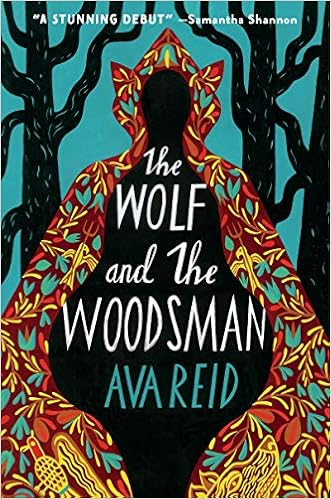 In her forest-veiled pagan village, Évike is the only woman without power, making her an outcast clearly abandoned by the gods. The villagers blame her corrupted bloodline—her father was a Yehuli man, one of the much-loathed servants of the fanatical king. When soldiers arrive from the Holy Order of Woodsmen to claim a pagan girl for the king’s blood sacrifice, Évike is betrayed by her fellow villagers and surrendered. But when monsters attack the Woodsmen and their captive en route, slaughtering everyone but Évike and the cold, one-eyed captain, they have no choice but to rely on each other. Except he’s no ordinary Woodsman—he’s the disgraced prince, Gáspár Bárány, whose father needs pagan magic to consolidate his power. Gáspár fears that his cruelly zealous brother plans to seize the throne and instigate a violent reign that would damn the pagans and the Yehuli alike. As the son of a reviled foreign queen, Gáspár understands what it’s like to be an outcast, and he and Évike make a tenuous pact to stop his brother. As their mission takes them from the bitter northern tundra to the smog-choked capital, their mutual loathing slowly turns to affection, bound by a shared history of alienation and oppression. However, trust can easily turn to betrayal, and as Évike reconnects with her estranged father and discovers her own hidden magic, she and Gáspár need to decide whose side they’re on, and what they’re willing to give up for a nation that never cared for them at all.
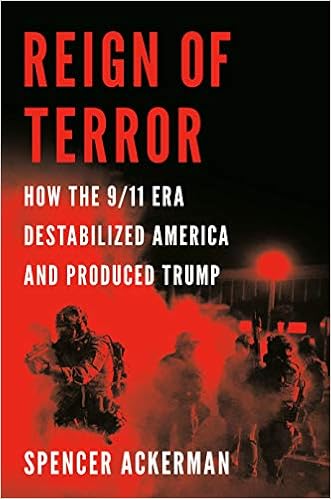 For an entire generation, at home and abroad, the United States has waged an endless conflict known as the War on Terror. In addition to multiple ground wars, it has pioneered drone strikes and industrial-scale digital surveillance, as well as detaining people indefinitely and torturing them. These conflicts have yielded neither peace nor victory, but they have transformed America. What began as the persecution of Muslims and immigrants has become a normalized, paranoid feature of American politics and security, expanding the possibilities for applying similar or worse measures against other targets at home. A politically divided country turned the War on Terror into a cultural and then tribal struggle, first on the ideological fringes and ultimately expanding to conquer the Republican Party, often with the timid acquiescence of the Democratic Party. Today’s nativist resurgence walked through a door opened by the 9/11 era.
 These new and collected essays from the acclaimed naturalist Barry Lopez—his final undertaking—represent the culmination of a lifetime’s thought in service of our relationship with wilderness, and with each other. Here, his collected essays offer a unifying vision; his drive to reconnect the cultural and the natural is unflinching, and major, never-published pieces offer profound commentary on topics that veer from the autobiographical—his abuse as a child—to the evolution of his views on the untamed. His classic prose, like the arctic landscape he elegized, remains as ever: “spare, balanced, extended…” It has been said that Barry Lopez understood what we gain when we accept the enormity of what we don’t know; these essays hinge on that tantalizing concept.