
Where do we belong if we don’t fit in? A memoir about what it means to defy expectations as a woman, a mother and an artist, for readers of Joan Didion and Gloria Steinem and listeners of the podcast Wiser than Me.
BIG GIRLS DON’T CRY:
A Memoir About Taking Up Space
by Susan Swan
foreword by Margaret Atwood
HarperCollins Canada, April 2025
Susan Swan has never fit inside the boxes that other people have made for her—the daughter box, the wife box, the mother box, the femininity box. Instead, throughout her richly lived, independent decades, she has carved her own path and lived with the consequences.
In this revealing and revelatory memoir, Swan shares the key moments of her life. As a child in a small Ontario town, she was defined by her size—attracting ridicule because she was six-foot-two by the age of twelve. She left her marriage to be a single mother and a fiction writer in the edgy, underground art scene of 1970s Toronto. In her forties, she embraced the new freedom of the Aphrodite years. Despite the costs to her relationships, Swan kept searching for the place she fit, living in the literary circles of New York while seeking pleasure and spiritual wisdom in Greece, and culminating in the hard-won experience of true self-acceptance in her seventies.
Swan examines the expectations of women of her generation and beyond using the lens of her then-unusual height as a metaphor for the way women are expected not to take up space in the world. Inspiring and thought-provoking, BIG GIRLS DON’T CRY invites us to re-examine what we’ve been taught to believe about ourselves and ask how it could be different.
“[Swan’s writing offers] not only an enjoyable read, but also the chance to think and reflect on the vast complex living entity that is the world. » —Nobel Prize-winner Olga Tokarczuk
Susan Swan is a novelist and non-fiction writer and a professor emerita at York University. Her books include The Wives of Bath, The Biggest Modern Woman in the World, What Casanova Told Me, The Western Light and Stupid Boys Are Good to Relax With. She is also co-founder of the Carol Shields Prize for Fiction, the largest literary prize for women and non-binary writers in Canada and the United States.
 Healers, shamans, priests, midwives, soothsayers: in antiquity, female communities and networks exchanged valuable, even life-saving, knowledge about nursing, healing, spirituality and sexuality. But in our patriarchal societies with their male-dominated academic discourse, female knowledge was often dismissed as irrelevant or un-serious and esoteric.
 When Nancy Reddy had her first child, she found herself suddenly confronted with the ideal of a perfect mother—a woman who was constantly available, endlessly patient, and immediately invested in her child to the exclusion of all else. Nancy had been raised by a single working mother, considered herself a feminist, and was well on her way to a PhD. Why did doing motherhood “right” feel so wrong?
 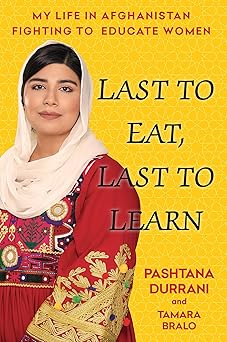 LAST TO EAT, LAST TO LEARN is the remarkable memoir of Pashtana Durrani, a 23-year-old Afghan woman, who has pursued her passion for educating the “disappearing girls” of the remote, contested rural tribal regions, amidst all the turmoil, violence and oppression that has enveloped her country – and her family — over a generation.
 Where mostly male behavioral psychologists have previously dominated the categories of happiness and optimization, Corinne, a professor at University of Pennsylvania’s Wharton School, applies economic principles to uniquely female concerns. Teaching readers how to use concepts like personal utility function (how we individually maximize profit and joy) and constrained optimization (making the best choice within external limits) to think about decisions and tradeoffs like the cost of a biological clock, Corinne will arm women with the tools they need to ask for more: from their partners, from their bosses, and from the system itself.