
From the author of Thin Girls, a page-turning feminist novel that tells the story of how a poor girl coming of age in rural New Zealand grows to be a sex icon, the face of a movement, and a mother, all at the same time.
THE HOP
by Diana Clarke
Harper, June 2022
(via Writers House)
 Kate Burns grows up wanting attention from her Ma, but her Ma wants only money and Kate learns how to get both. She and her childhood friend, Lacey, run kissing lessons for cash in the janitor’s closet of Fenbrook High, and, just like that, they find themselves in the sex work industry. When Ma dies, Kate discovers that the men her Ma was always inviting over to their home were, in fact, clients. Ma was no stranger to sex work either.
Following in Ma’s footsteps, Kate heads to Nevada where she picks up a job at America’s largest and most successful brothel: The Hop. In her new life as a Bunny, Kate searches for an identity she can perform—the other Bunnies include a goth, a housewife, a hippy, a rebel, all of them acting their archetype flawlessly. She befriends Betty, a trans woman who is a Bunny for kicks rather than cash; Mia, who is marketed as The Asian Persuasion; Dakota and Rain, who are ex-dominatrixes and newly in love. Kate becomes Lady Lane. Lady quickly becomes a bestselling Bunny and the owner Daddy’s favorite at this high-class establishment. But when ten street workers are killed in a nearby city, just bodies with no names, Lady joins her sister Bunnies in mourning and begins to see things in a new light.
Lady’s success breeds scandal and unwanted fame, deeply affecting her, transforming her life and The Hop forever. Diana Clarke’s provocative second novel is subversive in the very best way, an unforgettable work of fiction with a feminist message that couldn’t be more important.
Purdue MFA (with Roxane Gay as her thesis adviser) and University of Utah PhD candidate, Diana Clarke is a New Zealander who now lives in Salt Lake City. Her work has been published in Glimmer Train, The Rumpus, Black Warrior Review, The Master’s Review, and Hobart, among other places. THE HOP is her second novel.
 The Latin term for the female genitalia, pudendum, means “parts for which you should be ashamed.” Until 1651, ovaries were called female testicles. The fallopian tubes are named for a man. Named, claimed, and shamed: Welcome to the story of the female body, as penned by men.
 Taking us from the slave era, when white women fought in court to keep “ownership” of their slaves, through the centuries of colonialism, when they offered a soft face for brutal tactics, to the modern workplace, White Tears/Brown Scars tells a charged story of white women’s active participation in campaigns of oppression. It offers a long overdue validation of the experiences of women of color. Discussing subjects as varied as The Hunger Games, Alexandria Ocasio-Cortez, the viral BBQ Becky video, and 19th century lynchings of Mexicans in the American Southwest, Ruby Hamad undertakes a new investigation of gender and race. She shows how the division between innocent white women and racialized, sexualized women of color was created, and why this division is crucial to confront. Along the way, there are revelatory responses to questions like: Why are white men not troubled by sexual assault on women? (See Christine Blasey Ford.) With rigor and precision, Hamad builds a powerful argument about the legacy of white superiority that we are socialized within, a reality that we must apprehend in order to fight.
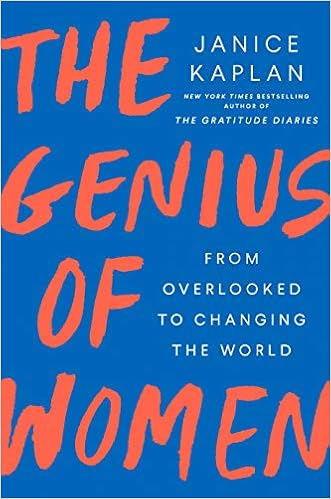 Even in this time of rethinking women’s roles, we define genius almost exclusively through male achievement. When asked to name a genius, people mention Albert Einstein, Leonardo da Vinci, and Steve Jobs. As for great women? In one survey, the only female genius anyone listed was Marie Curie. Janice Kaplan, the New York Times bestselling author of The Gratitude Diaries, set out to determine why the extraordinary work of so many women has been brushed aside. Using her unique mix of memoir, narrative, and inspiration, she makes surprising discoveries about women geniuses now and throughout history, in fields from music to robotics. Through interviews with neuroscientists, psychologists, and dozens of women geniuses at work in the world today—including Nobel Prize winner Frances Arnold and AI expert Fei-Fei Li—she proves that genius isn’t just about talent. It’s about having that talent recognized, nurtured, and celebrated. Across the generations, even when they face less-than-perfect circumstances, women geniuses have created brilliant and original work. In THE GENIUS OF WOMEN, you’ll learn how they ignored obstacles and broke down seemingly unshakable barriers. The geniuses in this moving, powerful, and very entertaining book provide more than inspiration—they offer a clear blueprint to everyone who wants to find her own path and move forward with passion.