
Rethinking climate change and democracy.
DEMOKRATIE IM FEUER
(Democracy in Flames)
by Jonas Schaible
DVA/PRH Germany, March 2023
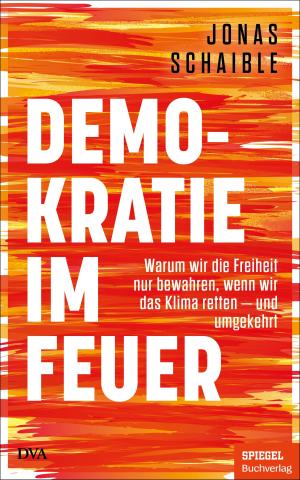 Many people think that protecting our climate and democracy are mutually exclusive. For some, the fight against climate change is moving too slowly, while others are already feeling threatened by the prospect of an « eco-dictatorship ». In DEMOKRATIE IM FEUER, journalist Schaible shows that protecting the climate and democracy are actually prerequisites for each other. Without one, the other will become impossible. He exposes false contradictions, and argues that what we need is « climate democracy » – for the climate crisis is already starting to limit our freedoms, and we’ll only be able to save the planet by democratic means. DEMOKRATIE IM FEUER takes a new look at the relationship between democracy and climate change, and sketches an optimistic vision of a future where the two reinforce each other.
Jonas Schaible, born in 1989, is an editor at Spiegel’s Berlin office. He studied politics and media studies in Tübingen and Berlin, and graduated with a degree in journalism from Hamburg’s Henri Nannen School. He has been writing regularly about climate change and climate policy since 2018, and won the German Reporter Prize for Best Essay for his feature « Wer von Ökodiktatur spricht, hat das Problem nicht verstanden » (‘If you’re talking about eco-dictatorships you haven’t understood the problem’).
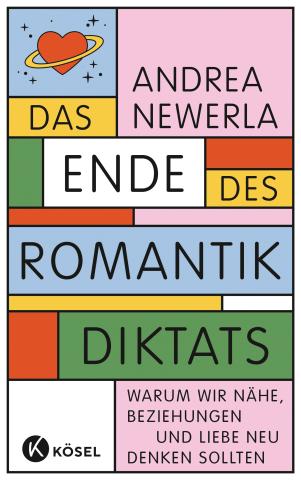 Our relationship with other people, closeness and intimacy has fundamentally changed. This is due not only to the « safe distances » and lockdowns of the past couple of years or so, but to a social trend that has merely been intensified by the pandemic – as evidenced by rising divorce rates, an increase in polyamorous relationships, the rising number of single households and political discussions around « responsible communities ».
 The catastrophe happens over coffee and cake: on a visit to his mother’s childhood friend in March 1943, Karlrobert Kreiten, a consummate 26-year-old pianist with a promising future ahead of him, claims that Germany has lost the war, and the Führer his mind. Six months after making these unguarded comments, he dies on the gallows.
 When we think of wilderness, we think of places like forests filled with an abundance of wild plants – landscapes that show no trace of human civilisation. After all, man and primordial nature are mutually exclusive. In fact, though, wilderness always implies a certain tug of war between different forces: wherever we disturb the balance, nature cannot take its course, and what remains isn’t wilderness, but an impoverished landscape – even if we leave nature to its own devices. Even now, the forests we once exploited contain just a fraction of the animals, plants and fungi that once existed there. Why is that? Biologist and filmmaker Haft examines flawed ideas, proposes a new way of conceiving of wilderness, and explains how – if we wanted to – we could easily and cheaply create new animal-friendly, sustainable and diverse landscapes.
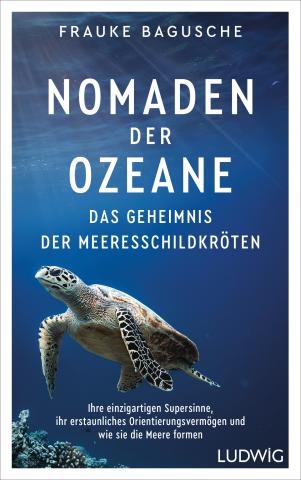 Turtles can do amazing things: some can dive to more than 1,000 metres, others transport organisms across the seas (and thus contribute to their distribution), others act as « architects of the oceans » by helping to spread coral reefs along the sea bed. All have impressive « super-senses », which mean they’re able to return to the beaches where they were born – often decades later, and from thousands of kilometres away. They orient themselves by the earth’s magnetic field, as well as their sense of smell, which allows them to recognise the scent of their first beach.