
From one of the brightest and most acclaimed new lights in YA fiction, a fantastic new novel about a bi Black boy finding first love… and facing the return of the mother who abandoned his preacher family when he was nine.
THINGS WE COULDN’T SAY
by Jay Coles
Scholastic, September 2021
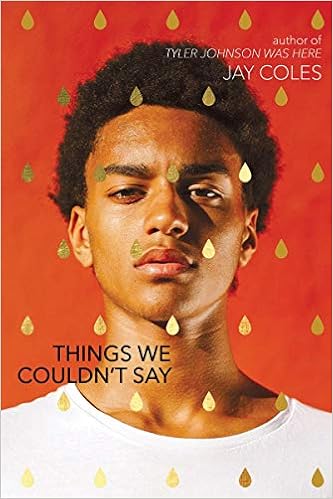 There’s always been a hole in Gio’s life. Not because he’s into both guys and girls. Not because his father has some drinking issues. Not because his friends are always bringing him their drama. No, the hole in Gio’s life takes the shape of his birth mom, who left Gio, his brother, and his father when Gio was nine years old. For eight years, he never heard a word from her . . . and now, just as he’s started to get his life together, she’s back. It’s hard for Gio to know what to do. Can he forgive her like she wants to be forgiven? Or should he tell her she lost her chance to be in his life? Complicating things further, Gio’s started to hang out with David, a new guy on the basketball team. Are they friends? More than friends? At first, Gio’s not sure . . . especially because he’s not sure what he wants from anyone right now. There are no easy answers to love— whether it’s family love or friend love or romantic love. In THINGS WE COULDN’T SAY, Jay Coles, acclaimed author of Tyler Johnson Was Here, shows us a guy trying to navigate love in all its ambiguity—hoping at the other end he’ll be able to figure out who is and who he should be.
Jay Coles is a graduate of Vincennes University and Ball State University. When he’s not writing diverse books, he’s advocating for them, teaching middle school students, and composing for various music publishers. His debut novel Tyler Johnson Was Here is based on true events in his life and inspired by police brutality in America. He resides in Indianapolis, Indiana.
 In just six years, ACT UP, New York, a broad and unlikely coalition of activists from all races, genders, sexualities, and backgrounds, changed the world. Armed with rancor, desperation, intelligence, and creativity, ACT UP, NY took on the AIDS crisis with an infatigable, ingenious, and multifaceted attack on the corporations, institutions, governments, and individuals who stood in the way of AIDS treatment for all. They stormed the FDA and NIH in Washington DC and started Needle Exchange in New York; they took over Grand Central terminal and fought to change the legal definition of AIDS to include women; they transformed the American insurance industry, weaponized art and advertising to push their agenda, and battled—and beat—the New York Times, the Catholic Church, and the pharmaceutical industry. AIDS Activism in its complex and intersectional power, transformed the lives of People With AIDS and the bigoted society that abandoned them.
 Todd is playing at the beach with his six-year-old son, Anthony, when he sees a man approach them. It is Jack, the man who made his highschool years a living hell. Radiant, repentant, and overjoyed to have « run into » Todd, Jack suggests a meal (to catch up!) and perhaps a night or two’s stay at Todd’s house (to reconnect!). Todd politely agrees, smile frozen on his face, as a sick feeling begins to grow within him, churning into rot and releasing a repressed darkness. What follows is a tense, fast-paced story of obsession and the grotesque, as disturbing as it is emotionally riveting. A Patricia Highsmith novel for the demented age we’re living through, HAWK MOUNTAIN is a compelling look at how love and hate are indissoluble, intertwined until the last breath.
 Three vastly different women: Shizuka Satomi, an aging, Hell-damned violin prodigy and teacher; Katrina Nyugen, a young transgender runaway and aspiring violinist; and Lan Tran, a spaceship captain running from a faraway war. Each woman descends on California’s predominantly Asian and Hispanic San Gabriel Valley seeking to rewrite her doomed fate. Each secretly dreams, despite forces working against her and closing in, of belonging to someone, of becoming someone’s family. Yet each is resigned to a life of carrying her burden alone. The only chance for Shizuka, Katrina, and Lan to survive on Earth rests in their finally recognizing who they are to one another — before it’s too late. LIGHT FROM UNCOMMON STARS will pull you in with its sensory pleasures, transportive depiction of place, masterful storytelling, and the warmth with which Aoki welcomes you into a neighborhood, as if you are already family. Aoki uses genre tropes to push the boundaries of imagination on behalf of her protagonists — people who, at the novel’s start, barely thought they were permitted to dream at all. Aoki’s characters, like herself, are women, queer, people of color. They are violinists full of innocence and regret. They are mothers trying to preserve the family business. They are refugees fleeing a war from beyond the stars. And they have come to the San Gabriel Valley, just outside of Los Angeles, a place where many drive past without a second thought, yet where others find magic and previously unthinkable love.
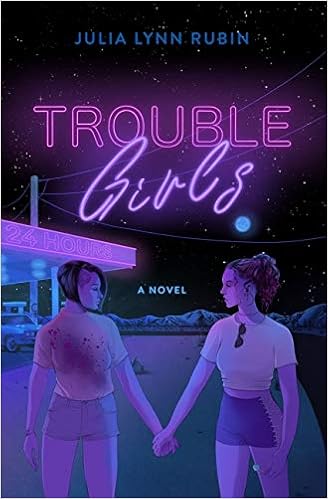 When Trixie picks up her best friend, Lux, for their first solo weekend getaway, she’s just looking to escape for a little while, to forget the despair of being trapped in her dead-end rustbelt town and the daunting responsibility of caring for her ailing mother. But a single moment of violence will forever change the course of the girls’ lives as they become wanted fugitives. Trying to stay ahead of the cops and a hellscape of media attention, the girls encounter an unforgiving landscape, rapidly diminishing supplies, and bad choices at every turn. As they are transformed by the media into the face of a #metoo movement they didn’t ask to lead and the road before them runs out, Trixie and Lux realize that they can only rely on each other and that the love they find together is the one thing that truly makes them free.