
Do you ever look up to the stars and wonder about what is out there? An accessible science narrative for readers of Astrophysics for People in a Hurry, this book allows readers to eavesdrop on a conversation between two Award-winning physicists and delve into a multidisciplinary discussion of our understanding of the universe.
WHERE DID THE UNIVERSE COME FROM?
and Other Cosmic Questions: Our Universe, from the Quantum to the Cosmos
by Chris Ferrie & Geraint F. Lewis
Sourcebooks, September 2021
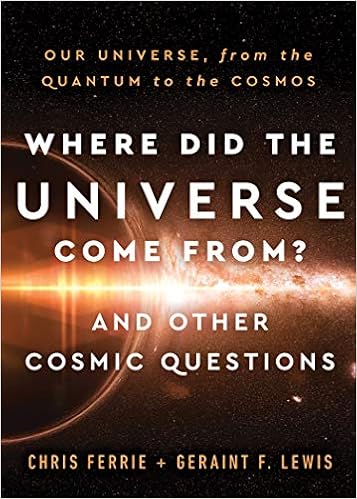 Over the last few centuries, humans have successfully unraveled much of the language of the universe, exploring and defining formerly mysterious phenomena such as electricity, magnetism, and matter through the beauty of mathematics. But some secrets remain beyond our realm of understanding—and seemingly beyond the very laws and theories we have relied on to make sense of the universe we inhabit. It is clear that the quantum, the world of atoms and electrons, is entwined with the cosmos, a universe of trillions of stars and galaxies…but exactly how these two extremes of human understanding interact remains a mystery. WHERE DID THE UNIVERSE COME FROM? and Other Cosmic Questions allows readers to eavesdrop on a conversation between award-winning physicists Chris Ferrie and Geraint F. Lewis as they examine the universe through the two unifying and yet often contradictory lenses of classical physics and quantum mechanics, tackling questions such as: Where did the universe come from? Why do dying stars rip themselves apart? Do black holes last forever? What is left for humans to discover?
A brief but fascinating exploration of the vastness of the universe, this book will have armchair physicists turning the pages until their biggest and smallest questions about the cosmos have been answered.
Chris Ferrie is an award-winning physicist and Senior Lecturer for Quantum Software and Information at the University of Technology Sydney. He has a BMath in Mathematical Physics and a PhD in Applied Mathematics. He lives in Australia with his wife and children.
Geraint F. Lewis is an award-winning astrophysicist and Professor of Astrophysics at the Sydney Institute for Astronomy.
 A fearless Burmese warlord, Olive Yang dressed, smoked, fought, and loved like one of the boys, rebelling against the confines of her gender from a very young age and later carrying on eyebrow-raising love affairs with a movie starlet, a General’s wife, and her own prison warden, amongst others. Beloved and revered by her soldiers, this trailblazing woman reigned over a powerful army that controlled the Golden Triangle from the end of World War II to the early 1960s, and infamously assisted the CIA in their plan to arm militias against Communist Chinese troops. Perhaps most fascinatingly of all, this female firebrand has largely been forgotten, relegated solely to the footnotes of history books. Until a few years ago, no one even seemed to know whether Olive was alive or dead. Determined to right this wrong, Gabrielle Paluch set out on a once-in-a-lifetime journey to find Olive Yang. What she found is, as they say, stranger than fiction.
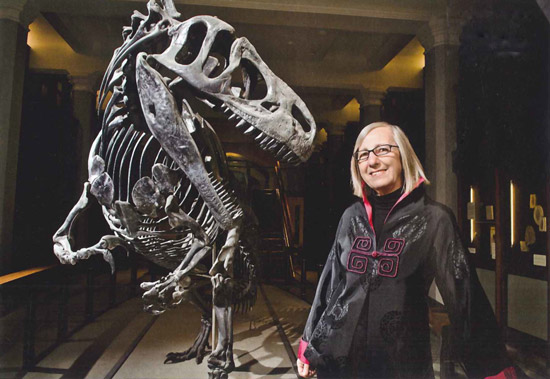 World-renowned geologist and paleontologist Gerta Keller is at the center of what has been called the nastiest feud in science, a contentious debate popularly known as “The Dinosaur Wars” over what triggered the fifth mass extinction at the end of the Cretaceous Era sixty-six million years ago. Dinosaurs have enthralled us for generations, and the question of what caused their demise is more relevant than ever, as humankind confronts the paroxysms of an imperiled planet and the possibility that we may become the dinosaurs of the sixth extinction.
 As an entrepreneur launching a girls’ health and wellness company, Kimberly Wolf found herself talking to many high-powered male investors, creatives, and advisors. But what they wanted to talk about took her by surprise. They all wanted to ask questions about their teenage daughters—what they should say to them, what they should do for them, or whether they should step aside and leave it to mom (or just wait it out).
 There is the initial pain of loss, and then there is the grieving. We have long assigned grief to the realm of nebulous emotions, but we now know that the brain creates those emotions in response to many outside factors. Neuroscientist Mary-Frances O’Connor has been studying the effects of grief on the brain and body for more than twenty years, and the clues she has found as to how we cope with loss turn out to be rooted in how we fall in love. In THE GRIEVING BRAIN, she explores this new territory and explains what happens inside the brain when we become attached to another and then lose that loved one—and why it can be so difficult to imagine a future without them. (Hint: Sometimes the brain leads us to believe the death is just not true.)