
This genre-bending debut collection of stories constructs eight eerie worlds full of desire, wisdom, and magic blooming amidst decay. For readers of Carmen Maria Machado and Karen Russell.
FRUITING BODIES: STORIES
by Kathryn Harlan
W.W. Norton, June 2022
(via The Gernert Company)
 In stories that beckon and haunt, FRUITING BODIES ranges confidently from the fantastical to the gothic to the uncanny as it follows characters—mostly queer, mostly women—on the precipice of change. Echoes of timeless myth and folklore reverberate through urgent narratives of discovery, appetite, and coming-of-age in a time of crisis.
In “The Changeling,” two young cousins wait in dread for a new family member to arrive, convinced that he may be a dangerous supernatural creature. In “Endangered Animals,” Jane prepares to say goodbye to her almost-love while they road-trip across a country irrevocably altered by climate change. In “Take Only What Belongs to You,” a queer woman struggles with the personal history of an author she idolized, while in “Fiddler, Fool, Pair,” an anthropologist is drawn into a magical—and dangerous—gamble. In the title story, partners Agnes and Geb feast peacefully on the mushrooms that sprout from Agnes’s body—until an unwanted male guest disturbs their cloistered home.
Audacious, striking, and wholly original, FRUITING BODIES offers stories about knowledge in a world on the verge of collapse, knowledge that alternately empowers or devastates. Pulling beautifully, brazenly, from a variety of literary traditions, Kathryn Harlan firmly establishes herself as a thrilling new voice in fiction.
« A debut of astonishing range and beauty, nimble and magical and profound. In stunning prose, Kathryn Harlan’s wildly imaginative and daring stories reveal the anguish of growing up in a dying world. Her characters’ quest for knowledge―about themselves, their families, their bodies, and their yearnings―will thrill and haunt you. » ― Jessamine Chan, author of The School for Good Mothers
Kathryn Harlan received an MFA from the University of Wisconsin–Madison, where she now teaches writing. She was the recipient of the 2019 August Derleth Graduate Creative Writing Prize. Her work has appeared in the Gettysburg Review, Strange Horizons, and elsewhere.
 Liv Reese wakes up in the back of a taxi with no idea where she is or how she got there. When she’s dropped off at the door of her brownstone, a stranger answers—a stranger who now lives in her apartment and forces her out in the cold. She reaches for her phone to call for help, only to discover it’s missing, and in its place is a bloodstained knife. That’s when she sees that her hands are covered in black pen, scribbled messages like graffiti on her skin: STAY AWAKE.
 A young woman puts on a white coat for her first day as a student doctor. So begins this powerful debut, which follows our unnamed narrator through cadaver dissection, surgical rotation, difficult births, sudden deaths, and a budding relationship with a seminarian. In the troubled world of the hospital, where the language of blood tests and organ systems so often hides the heart of the matter, she works her way from one bed to another, from a man dying of substance use and tuberculosis, to a child in pain crisis, to a young woman, fading from confusion to aphasia to death. The long hours and heartrending work begin to blur the lines between her new life as a physician and the lifelong traumas she has fled.
  DIANAWORLD is a fascinating, multi-faceted portrait of Diana, Princess of Wales—the person, the cultural figure, and the enduring mythology of the “People’s Princess”—exploring her relationships with those who knew her intimately, those who worked with and for her, and the many ordinary people from Britain, America, and elsewhere who felt connected to her. In some chapters, White will pay particular attention to Diana’s relationship with one person; in others, there will be a wider cast of characters. But in each case these relationships will connect to a theme highly germane to her private life, and her public reputation, providing an opportunity to question unexamined assumptions, as well as branching out into areas unexplored by straightforward biographies of Diana. This is a book about what Diana means to “us.”
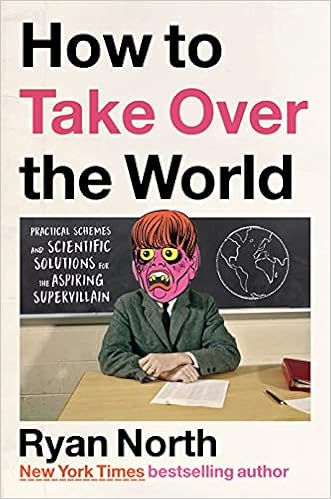 Taking over the world is a lot of work. Any supervillain is bound to have questions: What’s the perfect location for a floating secret base? What zany heist will fund my immoral plans? How do I control the weather, destroy the internet, and never, ever die? In How to Take Over the World, bestselling author and award-winning comics writer Ryan North details a number of outlandish villainous schemes, drawing on known science and real-world technologies. Picking up where How to Invent Everything left off, his explanations are as fun and informative as they are completely absurd. As he instructs readers on how to take over the world, North also reveals how we can save it. This sly guide to some of the greatest challenges and existential threats facing humanity accessibly explores ways to mitigate climate change, improve human life spans, prevent cyberterrorism, and finally make Jurassic Park a reality.