
A heart-warming companion through grief and pain following the death of a beloved pet.
ABSCHIED VOM GELIEBTEN HUND
(Goodbye, Faithful Friend)
by Elli H. Radinger
Ludwig/PRH Verlagsgruppe, March 2022
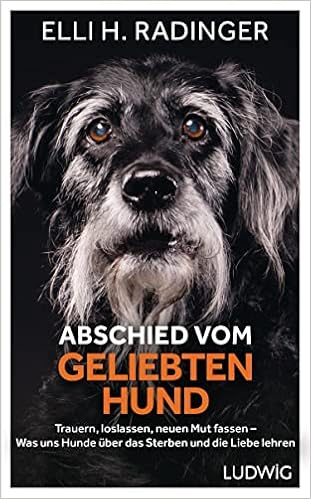 When her Labrador Shira died and Elli Radinger spoke publicly about her grief, thousands got in touch with the well-known wolf and dog expert to tell her about their own old, sick or deceased pets, as well as their deep sadness, desperation, loneliness and helplessness – because those around us often don’t understand our pain. Radinger wants to help those who are affected by this, and give them the strength they need during this difficult time, whether they are caring for a dying dog, or grieving for one that has already passed away. Saying goodbye to your faithful friend doesn’t have to be just the end of something – it can also be a gift, and even bring forth something new.
Radinger shows us how to be strong and confident, as we bravely submit to our beloved dog’s farewell gift, and what we can learn from our pet’s final moments. A moving book for all those who want to help themselves and their pets to say goodbye, and a heart-warming companion through the grief and pain that follow the death of a pet – a book that will help you face life afterwards with renewed hope and confidence.
Elli H. Radinger, born in 1951, gave up her law career to devote herself entirely to her true passions: writing and wolves. Her books Die Weisheit der Wölfe, Die Weisheit alter Hunde and Das Geschenk der Wildnis are bestsellers and have been translated into numerous languages.
 It’s an eventful year: a new Pope is elected in Rome, Howard Carter discovers the tomb of Tutankhamun, Albert Einstein receives the Nobel Prize, and the assassination of Germany’s foreign secretary Walther Rathenau foreshadows the rise of Adolf Hitler.
 Viktoryia Andrukovič, the Belarusian human rights advocate and political activist, was born in 1994, the year that Lukashenko came to power. She knows her homeland only as a country under the yoke of an increasingly autocratic regime, and she spent her deprived and precarious adolescence there hoping for a better, freer future for her country. An opposition activist both before and after the 2020 presidential elections, she now works with Belarusian NGOs in exile.
 Travelling is simply wonderful – that joyful sensation of heading out into the big wide world to experience the wholly new, that feeling of freedom and openness to accidental encounters… and it’s not least the ideal chance to experience time, the world and yourself differently. Whether it’s the beauty of old pilgrims’ ways in Scandinavia or dark alleyways in Cairo, the effortlessness of the flip-flop-wearing guides to Guatemala’s Atitlán volcano, the dogs dozing idly in the Portuguese sun, nights in Blackpool or Tokyo …
 It’s a given that, as far as work is concerned, nothing these days is a given. The Second Machine Age of self-teaching computers and robots will revolutionise not only the job market, but also redefine what ‘work’ is in the first place, and why we still do it. What happens when machines do so much of the work that economies no longer need to rely on human productivity? Without the old wage labour society of the First Machine Age, our conception of work as defined by the nineteenth century will become a mere appendix – useless and outdated. The big prize we aim for will no longer be full-time work, but self-realisation, and the raffle tickets will change accordingly: society will cease to think of employment as the be-all and end-all, and place greater value on high-quality jobs and workplace conditions.