
Archives de catégorie : Popular Science

THE STORY OF CO2 IS THE STORY OF EVERYTHING de Peter Brannen

How carbon dioxide, the world’s most important substance, shaped the planet’s past and present—and holds the key to our future.

THE STORY OF CO2 IS THE STORY OF EVERYTHING
by Peter Brannen
Ecco, August 2025
(via DeFiore and Company)

Every year, we are dangerously warping the climate by putting gigantic amounts of carbon dioxide into the air. But CO2 isn’t merely the byproduct of burning fossil fuels—it is also fundamental to how our planet works. All life is ultimately made from CO2, and it has kept Earth bizarrely habitable for hundreds of millions of years. In short, it is the most important substance on Earth. But how is it that CO2 is as essential to life on Earth as it is capable of destroying it?

In THE STORY OF CO2 IS THE STORY OF EVERYTHING, award-winning science journalist Peter Brannen reveals how carbon dioxide’s movement through rocks, air, water, and life has kept our planet’s climate livable, its air breathable, and its oceans hospitable to complex life. Starting at the dawn of life almost 4 billion years ago, and working all the way up through today’s global climate crisis and beyond, he illuminates how CO2 has been responsible for the planet’s many deaths and rebirths, for shaping the evolution of life, and for the development of modern human society. And he argues that it’s only by reckoning with this deep planetary history that we can understand the cosmic stakes of our current moment on Earth—and how dangerous our experiment with the climate really is.

With groundbreaking research and a clear-eyed perspective, Brannen shows how a deep exploration of the carbon cycle across our planet’s history can shed light on the way forward for humanity, as we try to avert environmental catastrophe in the future. And it all begins with a richer understanding of the critical role of CO2 in our world.

Peter Brannen is a contributing writer at The Atlantic. He is the author of The Ends of the World, about the biggest mass extinctions in Earth’s history. His work has also appeared in the New York Timesthe Washington Post, and other publications.
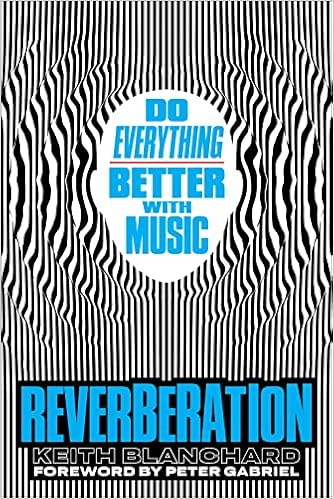
REVERBERATION de Keith Blanchard

Music is a universal human experience that’s been with us since the dawn of time. You’ve listened to music all your life . . . but have you ever wondered why?.

REVERBERATION:
Do Everything Better With Music
by Keith Blanchard
foreword by Peter Gabriel
Abrams Image, November 2022

Music is a universal human experience that’s been with us since the dawn of time. You’ve listened to music all your life … but have you ever wondered why? It turns out music isn’t just about entertainment—it’s a deeply embedded, subtly powerful means of communication. Songs resonate with your brain wave patterns and drive changes in your brain: creating your moods, consolidating your memories, strengthening your habits (the good ones and the bad ones alike) . . . even making you fall in or out of love.
Your music is molding you, at a subconscious level, all day long. And now, for the first time ever, you can take charge. 
From executive editor Peter Gabriel and the minds behind
It’s All in Your Head (the ultimate user’s guide for your brain), REVERBERATION unlocks a world where you can actively leverage the power of music to improve and enhance every aspect of your life. You’ll learn specific songs and techniques to help you sleep better, induce creative breakthroughs, be more productive, have better sex, and a whole lot more. 
You’ll discover the amazing work happening at the intersection of music, science, technology, and medicine. The authors spoke to dozens of neuroscientists making exciting breakthroughs, as well as top recording artists like David Byrne, Branford Marsalis, Hans Zimmer, Mick Fleetwood, and Sheila E. to gain the music maker’s perspective.
And you’ll learn how music is already being strategically applied to break addiction and reverse the effects of Alzheimer’s, build more productive and creative teams, develop intuitive personalized technology, and is otherwise changing … well, everything.

Keith Blanchard has contributed in various capacities to a wide range of publishing and production enterprises, including Cosmopolitan, Rolling Stone, and the Wall Street Journal, among others. Most recently he was the chief digital officer of World Science Festival. He lives in New York.
Peter Gabriel first rose to fame as the lead singer of the innovative progressive rock band Genesis. After leaving Genesis in 1975, Gabriel launched a successful solo career with the hit single “Solsbury Hill.” Gabriel has championed a series of humanitarian projects and participated in numerous benefit concerts for different causes, both on and off stage. To date, Gabriel has won six Grammy Awards and 13 MTV Video Music Awards. He has twice been inducted into the Rock & Roll Hall of Fame, first as a member of Genesis, and again as a solo artist. In recognition of his many years of human rights activism, he received the Man of Peace award from the Nobel Peace Prize laureates, and TIME magazine named him one of the 100 most influential people in the world. He lives in Wiltshire, England.

IF NIETZCHE WERE A NARWHAL de Justin Gregg

Funny and counter-intuitive, IF NIETZSCHE WERE A NARWHAL reveals how human intelligence may actually be more of a liability than a gift, and how the animal kingdom, in all its diversity, gets by just fine without it.

IF NIETZCHE WERE A NARWHAL:
What Animal Intelligence Reveals About Human Stupidity
by Justin Gregg
Little, Brown, August 2022
(via Writers House)

At first glance, human history is full of remarkable feats of intelligence. We invented writing. Produced incredible achievements in music, the arts, and the sciences. We’ve built sprawling cities and traveled across oceans—and space—and expanded to every part of the globe.

Yet, human exceptionalism can be a double-edged sword. With our unique cognitive prowess comes severe consequences, including existential angst, violence, discrimination, and the creation of a world teetering towards climate catastrophe. Understood side-by-side, human exceptionalism begins to look more like a curse.
As scientist Justin Gregg persuasively argues, there’s an evolutionary reason why human intelligence isn’t more prevalent in the animal kingdom. Simply put, non-human animals don’t need it to be successful. And, miraculously, their success arrives without the added baggage of destroying themselves and the planet in the process.
In seven mind-bending and hilarious chapters, Gregg highlights one feature seemingly unique to humans—our use of language, our rationality, our moral systems, our so-called sophisticated consciousness—and compares it to our animal brethren. What emerges is both demystifying and remarkable, and will change how you look at animals, humans, and the meaning of life itself.
Destined to become a classic, IF NIETZSCHE WERE A NARWHAL asks whether we are in fact the superior species. It turns out, the truth is stranger—and far more interesting—than we have been led to believe.

Justin Gregg is a Senior Research Associate with the Dolphin Communication Project and an Adjunct Professor at St. Francis Xavier University where he lectures on animal behavior and cognition. Originally from Vermont, Justin studied the echolocation abilities of wild dolphins in Japan and The Bahamas. He currently lives in rural Nova Scotia where he writes about science and contemplates the inner lives of the crows that live near his home.

QUANTUM PHYSICS MADE ME DO IT de Jeremie Harris

An exploration of cutting-edge physics and the implications that the scientific theory has for who we are and how our society should be structured.

QUANTUM PHYSICS MADE ME DO IT
by Jeremie Harris
Penguin Canada, May 2022
(via Levine Greenberg Rostan)

The discovery of quantum mechanics has paved the way to just about every important innovation in the last half century. It has led us to the technology that powers microwaves, iPhones, and self-driving cars and is about to trigger a computing revolution that will either spell the end of the human species or propel us to heights we’ve never imagined.
Without question, quantum mechanics is the single most successful scientific theory in human history. And, contrary to popular belief, it is also one of the simplest — y
ou don’t need to know math, have fancy degrees or be buried in a mountain of student loans to understand it.
But there’s another reason that quantum mechanics is so important: it is really the only way we can understand ourselves and each other. For the last hundred years or so, physicists have been feverishly debating what quantum theory has to say about you: what you’re made of, whether you have free will, what will happen to you when you die, and much more. Are human beings immortal? Are apples conscious? Do our legal systems make assumptions about free will that are just plain wrong?
QUANTUM PHYSICS MADE ME DO IT
is an amusing, irreverent exploration of our most successful scientific theory and the implications it has for who we are and how our society should be structured. In a disarming and amusing tone, it presents the reader with intuitive, battle-tested and high-school friendly explanations of these otherwise intimidating topics. It illustrates these concepts with “kets” – the glorified doodles used by physicists themselves as explanatory tools – to painlessly break down deep questions that are hotly debated to this day within the quantum physics community, and which have implications for human self-perception, law, and social structure.

Jeremie Harris has the uncanny ability to make the most esoteric, theoretical science not just understandable — but incredibly engaging. I am fairly certain that nobody else could have explained quantum physics to me in a way that gave me a solid and deep understanding of the processes at work — enough that I could turn around and teach them to someone else. And like the best professors, Harris is compulsively captivating, funny, and engrossing. This isn’t a lecture; it’s entertainment that feeds the brain.” Jodi Picoult, #1 NYT bestselling author of The Book Of Two Ways

Jeremie Harris received a Master’s in Physics from the University of Toronto in 2013. His academic research in quantum mechanics has been featured in many of the top peer-reviewed journals in physics including Nature Physics, Physical Review Letters and Optica. For his research, he was awarded the Vanier Scholarship, Canada’s most prestigious graduate research award, equivalent to the Rhodes or Fulbright scholarships in the UK and US. In 2016, after completing most of a PhD studying the foundations of quantum mechanics, Jeremie founded an artificial intelligence startup which eventually became SharpestMinds, a mentorship program for aspiring machine learning and AI specialists. With over 500 alumni and $15 million in new salaries created, it’s the world’s first profitable income share program, and they’ve gone on to raise funds from top Silicon Valley investors. Jeremie hosts the official podcast of Towards Data Science, a Medium publication with over 20 million monthly views, focused on AI, machine learning and the future of humanity. He is 30 years old.

VIRTUAL SOCIETY de Herman Narula

An eye-opening, myth-busting exploration of the metaverse, its ancient origins, and how the exchange of value and ideas within virtual words will expand the possibilities of human life—from the visionary co-founder of one of today’s most innovative technology companies

VIRTUAL SOCIETY:
The Metaverse and the New Frontiers of Human Experience
by Herman Narula
‎ Currency/Crown, October 2022

The concept of “the metaverse” has recently exploded in the public consciousness. But its contours remain elusive. Is it merely an immersive virtual reality playground, one which Facebook and other platforms will angle to control? Is it simply the next generation of massive multiplayer online games? Or is it something more revolutionary?
As Herman Narula shows, the metaverse is actually the latest manifestation of an ancient human tendency: the act of world building. From the Egyptians, whose conception of death inspired them to build the pyramids, to modern-day sports fans, whose passion for a game inspires extreme behavior, humans have long sought to supplement their day-to-day lives with a rich diversity of alternative experiences.
Rooting his vision in history and psychology, Narula argues that humans’ intrinsic need for autonomy, accomplishment, and connection can now best be met in virtual “worlds of ideas,” in which users will have the chance to create and exchange meaning and value. The metaverse is both the growing set of fulfilling digital experiences—ranging from advanced gaming, to entertainment experiences like concerts, and even virtual employment—as well as the empowering framework that allows these spaces to become “networks of useful meaning.”
Bloomberg Intelligence recently predicted the metaverse will become an $800 billon industry by 2024. But its potential, argues Narula, is far more awe-inspiring than as a spigot of cash. The arrival of the metaverse marks the beginning of a new age of exploration—not outward, but inward—with the potential to reshape society and open the door to a new understanding of the human species and its capabilities.
Rigorously researched and passionately argued, VIRTUAL SOCIETY will be a provocative and essential guide for anyone who wants to go beyond superficial headlines to understand the true shape and potential of our virtual future.

Herman Narula is the co-founder and CEO of Improbable, a London-based technology company. He holds a computer science degree from Cambridge. He’s interested in the unprecedented impact that powerful, virtual worlds have on how we think, play, and make decisions.