
Weaving together cultural criticism, personal narrative, historical diversions, and on-the-ground research, MAKE ME FEEL SOMETHING is a search for pure, loud, vibrant sensory experience and the knowledge that can only come from that source.
MAKE ME FEEL SOMETHING:
In Pursuit of Sensuous Life in the Digital Age
by Jennifer Schaffer-Goddard
Ecco/HarperCollins, Summer 2024
(via Sterling Lord Literistic)
 As physical life on earth grows increasingly fraught and imperiled, technology moves to take us out of our bodies and into our screens. Capital is flooding into the development of the metaverse, designed to engulf us even more fully in tech’s trackable, commodifiable sphere.
And as the influence of these newly manufactured modes of experience promises to grow more fixed and invasive, it is not hyperbole to suggest that the years ahead will require us to reckon with questions that, at first glance, may seem surreal: What is the point of physical life? What are our bodies for?
Although we are saturated by an overload of stimuli, we engage with our actual physical senses—touch, taste, sight, scent, and sound—less and less. It’s no surprise we face an epidemic of depression and disassociation; no wonder that, in an era that demands engagement, we often find ourselves numb, forgetful, and detached. We need an urgent and necessary alternative: a return to the vital purpose and pleasure of our embodied senses.
This is precisely the mission of MAKE ME FEEL SOMETHING, a multi-hyphenate work of narrative non-fiction offering a radical reappraisal of the five senses in our break-neck technological world, as well as our sense of time, place, and of self.
With the improbably intermingled properties of Jenny Odell’s How to Do Nothing, Samin Nosrat’s Salt Fat Acid Heat, and John Berger’s Ways of Seeing, MAKE ME FEEL SOMETHING is a personalized, thematically anchored quest narrative that proposes a defiant way forward for sensory life.
Jennifer Schaffer-Goddard was born in Chicago in 1992, the year Apple declared handheld devices would change the world. A 2021 finalist for the Krause Essay Prize, her work has appeared in The Nation, The Baffler, The Paris Review Daily, Vulture, The Times Literary Supplement, The Idler, The White Review, The New Statesman, and elsewhere in print and online. Her research on the societal impacts of artificial intelligence has received recognition and funding from the Royal Society, the Centre for the Future of Intelligence, and the Partnership on Artificial Intelligence in Cambridge and Oxford. A graduate of Stanford and the University of Cambridge, she has, for better or worse, spent several years working in the tech industry.
 Jesse Braddock is trapped, living in a tiny cabin deep in the Everglades with her infant daughter and her exboyfriend, a wannabe reality-TV star who turned out to be a lot prettier on the outside than on the inside. Broke and desperate for a way out, Jesse stumbles across a long-lost treasure, which could solve all her problems—if she can figure out how to keep it. The problem is, some very bad men are also looking for the treasure, and they know Jesse knows where it is. Meanwhile Jesse’s ex has become involved with Ken Bortle, of Bortle Brothers Bait & Beer, who has hatched an insane scheme to attract tourists to his failing store by making viral videos of a creature called the Everglades Melon Monster, which is in fact an unemployed alcoholic newspaperman named Phil wearing a repurposed Dora the Explorer costume head. Incredibly, this plan is wildly successful, which means a huge horde of Tik-Tokkers swarm into the swamp looking for the monster at the same time a variety of villains are hunting for Jesse. In the midst of this mayhem a presidential hopeful arrives in the Everglades to preside over the official launch of the Python Challenge. Needless to say it does not go as planned. In fact nothing in this story goes as planned. This is, after all, Florida.
 Each year, thousands of refugees hailing from far-flung origins in South Asia and sub-Saharan Africa pay anywhere from $20,000 to upwards of $60,000 a head to traverse the Western Hemisphere, using the Americas as a cross-continental land bridge to the U.S.-Mexico border. They all follow a nearly identical path: Beginning in Brazil; then on to Peru; then Ecuador; followed by Colombia, Panama, Costa Rica, Nicaragua, Honduras, and Guatemala, to reach Mexico. Last stop—the United States. A broken U.S. immigration system and the largest displacement of people in modern history, with some 50 million more migrants today than even just a decade ago, have together birthed this billiondollar black market of smuggling human beings across the world to the United States’ doorstep. This is “The Route.” No journalist or writer has covered “The Route” from start to finish—Molly O’Toole will be the first to do so. THE ROUTE
 “
“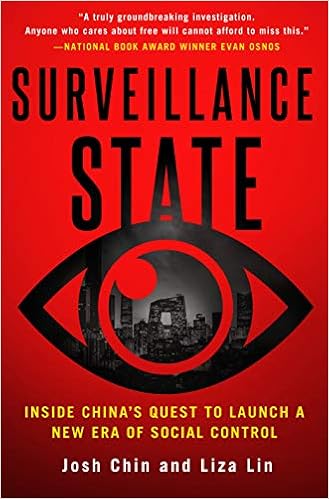 People living in democracies have for decades drawn comfort from the notion that their form of government, for all its flaws, is the best history has managed to produce. SURVEILLANCE STATE documents with startling detail how even as China’s Communist Party pays lip service to democracy as a core value of “socialism with Chinese characteristics,” it is striving for something new: a political model that shapes the will of the people not through the ballot box but through the sophisticated―and often brutal―harnessing of data.