
For readers of White Fragility, an explosive book of history and cultural criticism, which argues that white feminism has been a weapon of white supremacy and patriarchy deployed against Black and Indigenous women, and women of color.
WHITE TEARS/BROWN SCARS:
How White Feminism Betrays Women of Color
by Ruby Hamad
Catapult, October 2020
(chez MacKenzie Wolf – voir catalogue)
 Taking us from the slave era, when white women fought in court to keep “ownership” of their slaves, through the centuries of colonialism, when they offered a soft face for brutal tactics, to the modern workplace, White Tears/Brown Scars tells a charged story of white women’s active participation in campaigns of oppression. It offers a long overdue validation of the experiences of women of color. Discussing subjects as varied as The Hunger Games, Alexandria Ocasio-Cortez, the viral BBQ Becky video, and 19th century lynchings of Mexicans in the American Southwest, Ruby Hamad undertakes a new investigation of gender and race. She shows how the division between innocent white women and racialized, sexualized women of color was created, and why this division is crucial to confront. Along the way, there are revelatory responses to questions like: Why are white men not troubled by sexual assault on women? (See Christine Blasey Ford.) With rigor and precision, Hamad builds a powerful argument about the legacy of white superiority that we are socialized within, a reality that we must apprehend in order to fight.
Ruby Hamad is a journalist, author, and academic completing a Ph.D. in media studies at UNSW (Australia). Her Guardian article, ‘How White Women Use Strategic Tears to Silence Women of Color,’ became a global flashpoint for discussions of white feminism and racism and inspired her debut book, White Tears/Brown Scars, which has received critical acclaim in her home country of Australia. Her writing has also featured in Prospect Magazine, The New Arab, and more. She splits her time between Sydney and New York.
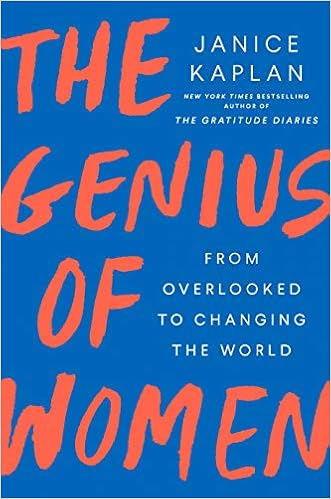 Even in this time of rethinking women’s roles, we define genius almost exclusively through male achievement. When asked to name a genius, people mention Albert Einstein, Leonardo da Vinci, and Steve Jobs. As for great women? In one survey, the only female genius anyone listed was Marie Curie. Janice Kaplan, the New York Times bestselling author of The Gratitude Diaries, set out to determine why the extraordinary work of so many women has been brushed aside. Using her unique mix of memoir, narrative, and inspiration, she makes surprising discoveries about women geniuses now and throughout history, in fields from music to robotics. Through interviews with neuroscientists, psychologists, and dozens of women geniuses at work in the world today—including Nobel Prize winner Frances Arnold and AI expert Fei-Fei Li—she proves that genius isn’t just about talent. It’s about having that talent recognized, nurtured, and celebrated. Across the generations, even when they face less-than-perfect circumstances, women geniuses have created brilliant and original work. In THE GENIUS OF WOMEN, you’ll learn how they ignored obstacles and broke down seemingly unshakable barriers. The geniuses in this moving, powerful, and very entertaining book provide more than inspiration—they offer a clear blueprint to everyone who wants to find her own path and move forward with passion.
  Most of us do not give much thought to the centerpiece of our bathrooms, but the toilet is an unexpected paradox. On the one hand, it is a modern miracle: a ubiquitous fixture in a vast sanitation system that has helped add decades to human lifespan by reducing disease. On the other hand, the toilet is also a tragic failure: less than half of the world’s population can access a toilet that safely manages bodily waste, including many right here in the United States. And it is inefficient, squandering clean water as well as the nutrients and energy contained in the waste we flush away. While we see radical technological change in almost every other aspect of our lives, we remain stuck in a sanitation status quo—in part because the topic of toilets is taboo. Fortunately, there’s hope—and PIPE DREAMS daringly profiles the growing army of scientists, engineers, philanthropists, entrepreneurs, and activists worldwide who are overcoming their aversions and focusing their formidable skills on making toilets accessible and healthier for all. This potential revolution in sanitation has many benefits, including reducing inequalities, mitigating climate change and water scarcity, improving agriculture, and optimizing health. Author Chelsea Wald takes us on a wild world tour from a compost toilet project in Haiti, to a plant in the Netherlands that harvests used toilet paper from sewage, and shows us a bot that hangs out in manholes to estimate opioid use in a city, among many other fascinating developments. Much more than a glorified trash can, the toilet, Wald maintains, holds the power to help solve many of the world’s problems, if only we can harness it.
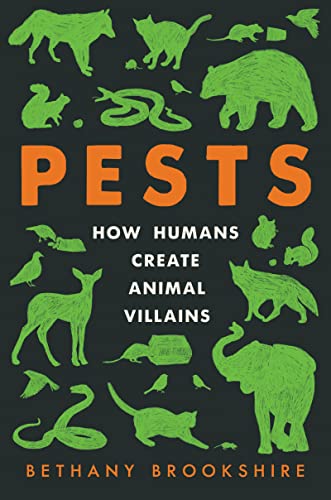 A squirrel in the garden. A rat in the wall. A pigeon on the street. Humans have spent so much of our history drawing a hard line between human spaces and wild places. When animals pop up where we don’t expect or want them, we respond with fear, rage, or simple annoyance. It’s no longer an animal. It’s a pest.
 THE MOTHERLODE highlights more than 100 women who have shaped the power, scope, and reach of rap music, including pioneers like Roxanne Shanté, game changers like Lauryn Hill and Missy Elliott, and current reigning queens like Nicki Minaj, Cardi B, and Lizzo—as well as everyone who came before, after, and in between. Some of these women were respected but not widely celebrated. Some are impossible not to know. Some of these women have stood on their own; others were forced into templates, compelled to stand beside men in big rap crews. Some have been trapped in a strange critical space between respected MC and object. They are characters, caricatures, lyricists, at times both feminine and explicit. This book profiles each of these women, their musical and career breakthroughs, and the ways in which they each helped change the culture of rap.