
In his New York Times bestselling book The End of Power, Moises Naim examined power-diluting forces. Now, in THE REVENGE OF POWER, Naim turns to the trends, conditions, and behaviors that are contributing to the concentration and augmentation of power and to the clash between the forces that weaken power and those that strengthen it.
THE REVENGE OF POWER:
The Global Assault on Democracy and How to Defeat It
by Moisés Naím
St. Martin’s Press, February 2022
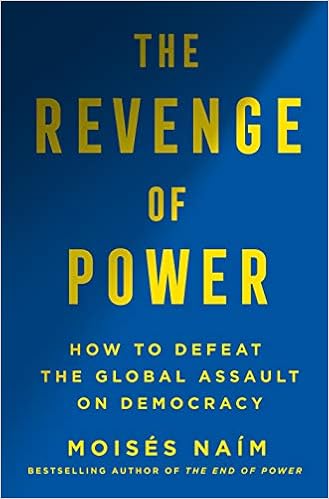 Moisés Naím concentrates on the three “P”s—populism, polarization, and post-truths. Using the best available data and insights taken from recent research in the social sciences, Naim reveals how the same set of strategies to consolidate power pop up again and again in places with vastly different political, economic, and social circumstances. The outcomes of these battles for power will determine if our future will be more autocratic or more democratic. These outcomes will, in turn, depend on the capacity of our democracies to survive the attacks and dirty tricks of autocratic leaders bent on weakening the checks and balances that limit their power. Naim addresses the questions at the heart of the matter: What are, in practice, those attacks and tricks? Why is power concentrating in some places while in others it is fragmenting and degrading? And the big question: what is the future of freedom?
Moisés Naím is a scholar at the Carnegie Endowment for International Peace and an internationally syndicated columnist. For over a decade he was the editor-in-chief of Foreign Policy magazine and under his leadership, the magazine was re-launched, won the National Magazine award for General Excellence three times and became one of the world’s most influential publications in international affairs. Naím also served as Venezuela’s Minister of Industry and Trade and as executive director of the World Bank. He holds a PhD from MIT and lives in Washington, DC.

 Wall Street Journal
 The Girls Who Stepped Out of Line are the heroes of the Greatest Generation that you hardly ever hear about. These women who did extraordinary things didn’t expect thanks and shied away from medals and recognition. Despite their amazing accomplishments, they’ve gone mostly unheralded and unrewarded. No longer. These are the women of World War II who served, fought, struggled, and made things happen―in and out of uniform. Liane B. Russell fled Austria with nothing and later became a renowned U.S. scientist whose research on the effects of radiation on embryos made a difference to thousands of lives. Gena Turgel was a prisoner who worked in the hospital at Bergen-Belsen and cared for the young Anne Frank, who was dying of typhus. Gena survived and went on to write a memoir and spent her life educating children about the Holocaust. Ida and Louise Cook were British sisters who repeatedly smuggled out jewelry and furs and served as sponsors for refugees, and they also established temporary housing for immigrant families in London. Retired U.S. Army Major General Mari K. Eder wrote this book because she knew their stories needed to be told―and the sooner the better. For theirs is a legacy destined to embolden generations of women to come.
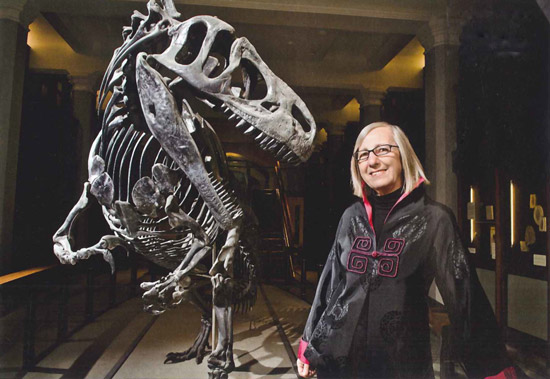 World-renowned geologist and paleontologist Gerta Keller is at the center of what has been called the nastiest feud in science, a contentious debate popularly known as “The Dinosaur Wars” over what triggered the fifth mass extinction at the end of the Cretaceous Era sixty-six million years ago. Dinosaurs have enthralled us for generations, and the question of what caused their demise is more relevant than ever, as humankind confronts the paroxysms of an imperiled planet and the possibility that we may become the dinosaurs of the sixth extinction.