
An examination of the profound impact that the War on Terror had in pushing American politics and society in an authoritarian direction.
REIGN OF TERROR:
How the 9/11 Era Destabilized America and Produced Trump
by Spencer Ackerman
Viking, August 2021
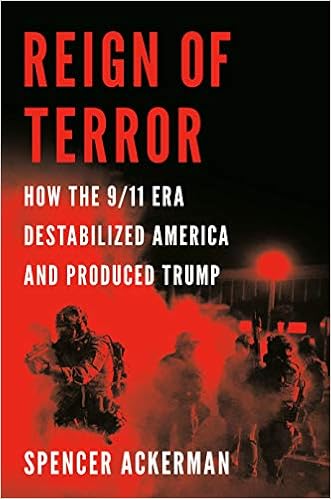 For an entire generation, at home and abroad, the United States has waged an endless conflict known as the War on Terror. In addition to multiple ground wars, it has pioneered drone strikes and industrial-scale digital surveillance, as well as detaining people indefinitely and torturing them. These conflicts have yielded neither peace nor victory, but they have transformed America. What began as the persecution of Muslims and immigrants has become a normalized, paranoid feature of American politics and security, expanding the possibilities for applying similar or worse measures against other targets at home. A politically divided country turned the War on Terror into a cultural and then tribal struggle, first on the ideological fringes and ultimately expanding to conquer the Republican Party, often with the timid acquiescence of the Democratic Party. Today’s nativist resurgence walked through a door opened by the 9/11 era.
REIGN OF TERROR will show how these policies created a foundation for American authoritarianism and, though it is not a book about Donald Trump, it will provide a critical explanation of his rise to power and the sources of his political strength. It will show that Barack Obama squandered an opportunity to dismantle the War on Terror after killing Osama bin Laden. That mistake turns out to have been portentous. By the end of his tenure, the war metastasized into a broader and bitter culture struggle in search of a demagogue like Trump to lead it. A union of journalism and intellectual history, REIGN OF TERROR will be a pathbreaking and definitive book with the power to transform how America understands its national security policies and their catastrophic impact on its civic life.
As a journalist, Spencer Ackerman has spent his entire career on subjects we would like to turn our heads away from. He broke the story of Homan Square in Chicago, and Dan Jones’ report on torture. Over the past 17 years, he covered national security and the war on terrorism as a staff reporter for The New Republic, Wired and The Guardian, as well as other publications, where he reported from Iraq, Afghanistan, Guantanamo Bay and a number of military bases, naval ships and submarines. While at the Guardian, he was part of the team reporting on Edward Snowden’s NSA leaks, which won the 2014 Pulitzer Prize for Public Service Journalism, the Scripps Howard Foundation’s 2014 Roy W. Howard Award for Public Service Reporting, and the 2013 IRE medal for investigative reporting. Ackerman’s Wired series on Islamophobic counterterrorism training at the FBI won the 2012 online National Magazine Award for reporting. He frequently appears on MSNBC, CNN and other news networks. He has over 147,000 Twitter followers.
 A fearless Burmese warlord, Olive Yang dressed, smoked, fought, and loved like one of the boys, rebelling against the confines of her gender from a very young age and later carrying on eyebrow-raising love affairs with a movie starlet, a General’s wife, and her own prison warden, amongst others. Beloved and revered by her soldiers, this trailblazing woman reigned over a powerful army that controlled the Golden Triangle from the end of World War II to the early 1960s, and infamously assisted the CIA in their plan to arm militias against Communist Chinese troops. Perhaps most fascinatingly of all, this female firebrand has largely been forgotten, relegated solely to the footnotes of history books. Until a few years ago, no one even seemed to know whether Olive was alive or dead. Determined to right this wrong, Gabrielle Paluch set out on a once-in-a-lifetime journey to find Olive Yang. What she found is, as they say, stranger than fiction.
 In the last census, Britain recorded over 1.2 million people who identified as mixed race. 6% of children under the age of 5 identify as mixed race, a higher number than any other Black and ethnic minority group in the country. So, why is it so hard for mixed race people to navigate their identity?
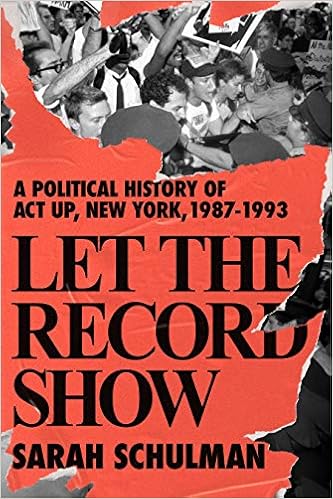 In just six years, ACT UP, New York, a broad and unlikely coalition of activists from all races, genders, sexualities, and backgrounds, changed the world. Armed with rancor, desperation, intelligence, and creativity, ACT UP, NY took on the AIDS crisis with an infatigable, ingenious, and multifaceted attack on the corporations, institutions, governments, and individuals who stood in the way of AIDS treatment for all. They stormed the FDA and NIH in Washington DC and started Needle Exchange in New York; they took over Grand Central terminal and fought to change the legal definition of AIDS to include women; they transformed the American insurance industry, weaponized art and advertising to push their agenda, and battled—and beat—the New York Times, the Catholic Church, and the pharmaceutical industry. AIDS Activism in its complex and intersectional power, transformed the lives of People With AIDS and the bigoted society that abandoned them.
 Taking us from the slave era, when white women fought in court to keep “ownership” of their slaves, through the centuries of colonialism, when they offered a soft face for brutal tactics, to the modern workplace, White Tears/Brown Scars tells a charged story of white women’s active participation in campaigns of oppression. It offers a long overdue validation of the experiences of women of color. Discussing subjects as varied as The Hunger Games, Alexandria Ocasio-Cortez, the viral BBQ Becky video, and 19th century lynchings of Mexicans in the American Southwest, Ruby Hamad undertakes a new investigation of gender and race. She shows how the division between innocent white women and racialized, sexualized women of color was created, and why this division is crucial to confront. Along the way, there are revelatory responses to questions like: Why are white men not troubled by sexual assault on women? (See Christine Blasey Ford.) With rigor and precision, Hamad builds a powerful argument about the legacy of white superiority that we are socialized within, a reality that we must apprehend in order to fight.